The Cover Story
House of VIBHINI · From Surat ·
Jewellery history, the life of pieces we make, short lessons and dated entries, checked and approved at our workshop in Surat, with a note from the bench every morning.
A Piece’s LifeNo. 2
From one oval drawn in CAD to a line of 137 stones round the neck: why each one is turned on its side, why each has a link of its own, and what the whole line weighs.
6 min read · Sources listed at the end
Week of 19 October · a note every morning, Monday to Saturday
Mon19
The Lesson16 December 1954NoteTue20
NoteWed21
NoteThu22
The Cover StoryDhanterasNoteFri23
NoteSat24
NoteWeek of 26 October · a note every morning, Monday to Saturday
Mon26
A Piece’s LifeThe east-west necklaceNoteTue27
NoteWed28
Note, to comeThu29
The LessonThe six-claw settingNote, to comeFri30
Note, to comeSat31
Note, to comeThen: Monday 2 November, The Cover Story. The next Almanac waits for its date, Tuesday 10 November. See what is coming
This fortnight · 19 to 26 October
The newest story of each of the four formats, each in its own look, all inside the same Stories pages.
The Cover Story
A Piece’s Life
The Lesson

Where are you starting from?
Note from the Bench · A word from the bench · Tuesday 27 October
A long stone, such as an oval, a pear or a marquise, set lying sideways: across the finger on a ring, along the chain on a necklace. The usual way on a ring is north-south, pointing along the finger. The pear on our east-west pear halo ring lies across the finger, in line with the band, and all 137 ovals in Monday’s necklace story lie along the chain.
From the bench, Surat
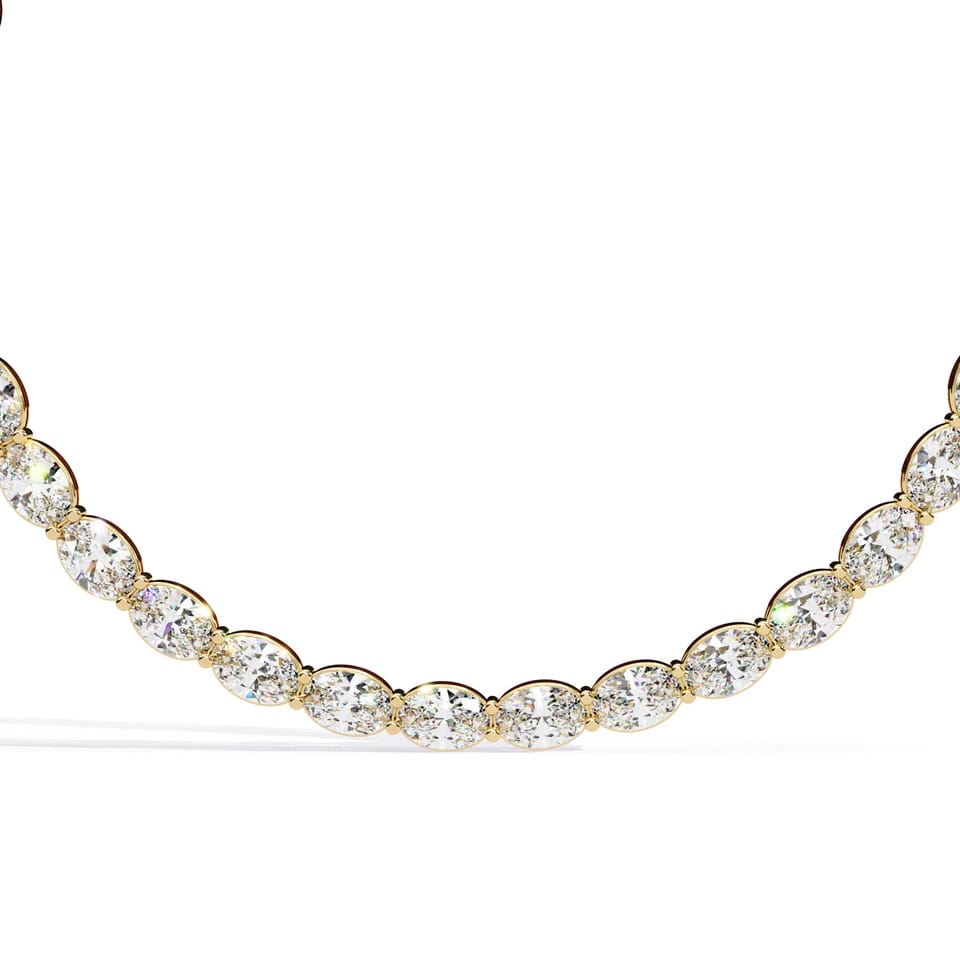
Each oval on our east-west tennis necklace sits in an open gold basket of its own, and where two ovals meet, a pair of small claws sits at the join, one above and one below. Because no two stones share a link, the line can lie flat and move. The necklace’s story
Our east-west tennis necklace is one line of 137 ovals, each 3.00 × 2.00 mm: 6.20 ct of laboratory-grown diamond in all, running the full length of the necklace. Every oval sits in a gold link of its own.
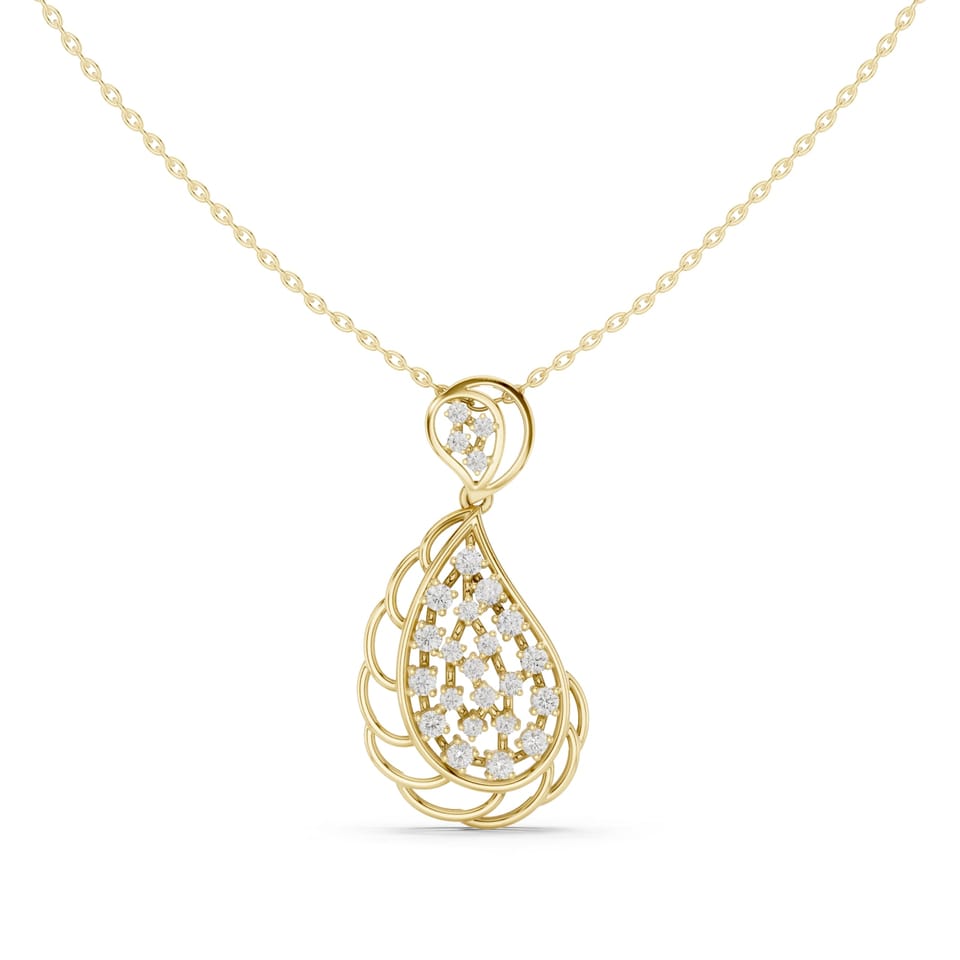
A motif shaped like a fan of palm leaves, spreading from a single base. On our palmette cluster studs, one gold leaf rises at the centre with a curl to either side, above a cluster of stones, 8 for the pair.
The curved teardrop with its tip turned over, known in India as the buta. In English it takes its name from Paisley, a Scottish town whose weavers copied the Kashmir shawls that carried it west. Our paisley two-stone studs are that shape in polished gold. The Cover Story on Dhanteras is out today.
The thin edge that runs round a cut stone at its widest, where its top meets its underside. It is where the claws take hold. On our round solitaire on a plain band, six claws meet the 6.60 mm stone at its girdle, and the rest of the stone is left open.
A made-to-order piece is made for you alone, so making starts quickly. Cancel within 12 hours of ordering and we refund everything you paid, with nothing deducted.
With a K, it is how much of the metal is gold. With a C, it is a stone’s weight, and one carat is 0.2 grams.
Our emerald-cut eternity band weighs 3.42 g in 9K gold and 4.76 g in 18K. The drawing doesn’t change: 18K simply holds twice the share of gold that 9K does. Gold karats, explained
On our emerald-cut eternity band, the claw where two stones meet catches the corners of both, so very little metal shows between them. How it’s set
The 19 emerald cuts of 4.50 × 3.25 mm on our eternity band weigh 4.88 ct in laboratory-grown diamond: just under a gram. A carat has been exactly a fifth of a gram since 1907. The band’s story
The size we make every ring in unless you ask for another: about 16.9 mm across the inside. Other sizes are made on request and quoted separately. Find your size
A small finger of metal that holds a stone at its edge. Our round solitaire with pavé shoulders uses six; our radiant-cut solitaire uses four.
Coming next
Not published yet. Each goes out on its date, and an Almanac entry waits for its own.
The Lesson
Until the 1880s, the stone in a ring often sat low against its band, among ornament. In 1886 a New York jeweller lifted one on six claws, and the solitaire took a shape still made today.
Path 2, lesson 1 of 3The Cover Story
Under the Mughals it was the empire’s most prosperous port. JCK reported in 2024 that Surat cuts more than nine in ten of the world’s mined diamonds. How the city became the Diamond City, from small stones to the largest office building in the world.
Stories in Stone, part 3The Almanac
On 10 November 1958 Harry Winston gave the Hope, a blue mined diamond from India, perhaps from the Kollur mine, to the Smithsonian. He sent it by registered mail, in a box wrapped in brown paper.
Waits for its dateThe Cover Story’s series, in eight parts
The history of the stones, the gold, the cuts and the settings we work with, from the mines of Golconda to the cuts of the twentieth century. Each part ends at a piece you can see, or have made.
The morning of 16 December 1954 is told as a Lesson: read it in The Lesson.
The bench in these stories also makes pieces for jewellery brands and retailers. If you are building a collection, our trade page sets out how to start, and our guide to working with a manufacturer in Surat explains what to ask any maker.

Stories is checked and approved at our workshop in Surat. Every date and figure carries its source at the end of the story, and if we can’t source it, we leave it out.
Ask us
Tell us which story, and what you have in mind. A piece from these pages, or one drawn for you: we will say plainly what can be made, and agree every detail with you in writing before anything is made.
Monday to Saturday, 10am to 7pm India time. WhatsApp +91 70434 07831.
Buying for a shop or brand? See our trade terms · Trade WhatsApp +91 84607 61366