The LessonPath 1, lesson 2 of 7
How the laboratory-grown diamond began: the morning of 16 December 1954
For 158 years, chemists knew that a mined diamond was nothing but carbon, and not one of them could grow one. Then a scientist at General Electric, working with a press of his own design, saw dozens of tiny crystals catch the light. This is that morning, and the two methods it led to.

In short
The first laboratory-grown diamond made by a reproducible process that others could verify was grown on 16 December 1954 by H. Tracy Hall at General Electric in Schenectady, New York, in a press he designed called the belt. Every laboratory-grown diamond today is grown in one of two ways: HPHT, which recreates the heat and pressure deep underground, or CVD, which builds the crystal from a carbon gas.
By the end of this lesson you will know
- who grew the first one, and why the date that matters is the one that could be repeated;
- how HPHT and CVD differ, in figures;
- what an IGI report says about the method, and what it doesn’t.
A paper read on 15 December 1796
Isaac Newton noticed that a mined diamond bends light more strongly than its density would suggest, as substances that burn tend to, and guessed that it might burn. Long after Newton, the guess became an experiment. On 15 December 1796 the English chemist Smithson Tennant read a paper to the Royal Society in London. He had heated a mined diamond with nitre, caught the gas it gave off, and found it gave about the same amount as an equal weight of charcoal. His conclusion was blunt: the stone was charcoal, “differing … only by its crystallized form”.
Knowing the ingredient turned out to be the easy half. Carbon was everywhere, in soot and in the graphite of a pencil. Arranging it into that crystal was the hard part, and for more than a century nobody managed it in a way someone else could repeat. In the 1890s the French chemist Henri Moissan claimed to have grown the first laboratory-grown diamond in his electric furnace. Other experimenters couldn’t reproduce it.
Moissan is remembered instead for a find of 1893: crystals in rock samples from Meteor Crater, near Canyon Diablo in Arizona, that he first took for the very stone he was trying to make. In 1904 he showed they were silicon carbide, the mineral later named moissanite in his honour. They were not diamonds, and moissanite still isn’t one. It is the subject of the next lesson.
Rubber boots and a ring of steel
In 1951, General Electric restarted its own attempt at its laboratories in Schenectady, New York, forming a high-pressure group with Francis Bundy and H. M. Strong. Among the GE scientists was H. Tracy Hall. For a time he worked at a 35-year-old press that leaked so much hydraulic water that he wore rubber boots beside it. He also designed an apparatus of his own: a ring of hardened steel, strained right up to the point where steel stops springing back, wrapped round a small sample. He called it the belt, and it could reach pressures above 10 gigapascals and temperatures above 2,000 °C.
A gigapascal is about 10,000 times the pressure of the air at sea level. Ten of them is roughly a tonne pressing on every square millimetre.
On the morning of 16 December 1954, a run held carbon with a metal catalyst at about 100,000 atmospheres and 1,600 °C. When Hall looked at the result, he saw dozens of tiny crystals flashing in the light.
“My hands began to tremble; my heart beat rapidly.”
H. Tracy Hall, remembering that morning
They were small. The largest of Hall’s crystals was about 0.15 mm across, too small for jewellery, though useful as an industrial abrasive. That didn’t matter. What made the morning history was that the process could be repeated, and it was: the first laboratory-grown diamond made by reproducible means that others could verify. GE announced it in February 1955.
There is a footnote, and a fair account includes it. On 16 February 1953 a team at the Swedish electrical company ASEA had already made crystals in Stockholm, in an apparatus designed by Baltzar von Platen and Anders Kämpe. They didn’t report it, and their result was announced only after GE’s.
From grit to gems, and a second road
Gems took longer. GE grew its first gem-quality crystals in 1970, by the same high-pressure route, and reported them in 1971.
By then a second road was open. In the early 1950s, at Union Carbide, William Eversole had deposited laboratory-grown diamond from a carbon gas onto a seed crystal; GIA dates the first documented growth to 1952. This is chemical vapour deposition, or CVD: carbon from a gas, laid down at pressures below that of the air we breathe, building a crystal in thin layers. By 2003, GIA’s journal Gems & Gemology was describing gem-quality CVD crystals a few millimetres thick and up to a carat or more: near-colourless to brown, and Type IIa, a term we will come back to.
The road to your stone, in ten dates
- 1796
Smithson Tennant’s paper: a mined diamond is nothing but carbon.
- 1893
Henri Moissan finds crystals in rock from Meteor Crater, Arizona; in 1904 he shows they are silicon carbide.
- 1951
General Electric forms its high-pressure group in Schenectady.
- 1952
William Eversole’s growth from a gas, the first step to CVD, is documented.
- 1953
16 February: ASEA makes crystals in Stockholm, and doesn’t report them.
- 1954
16 December: H. Tracy Hall’s run in the belt, the first that others could repeat.
- 1955
February: GE announces it.
- 1970
GE grows the first gem-quality crystals, reported in 1971.
- 2003
Gems & Gemology describes gem-quality CVD crystals.
- 2021
January: IGI reports begin to say whether a stone is “as grown”.
Two ways to grow a crystal
Every laboratory-grown diamond today comes from one of those two roads. Both start from a seed crystal for the new one to grow on, and both need carbon and heat. What differs is how the carbon reaches the seed.
| Feature | HPHT | CVD |
|---|---|---|
| Stands for | High pressure, high temperature | Chemical vapour deposition |
| The idea | Recreate the conditions deep underground | Build the crystal from a gas, layer on layer |
| Pressure | 5–6 gigapascals | Below the pressure of the air |
| Heat | 1,300–1,600 °C | About 900–1,200 °C |
| The carbon | High-purity carbon dissolved in molten metal | Methane, with hydrogen, broken up by a microwave plasma |
| Time to grow | An hour to a few weeks | Three or four weeks |
| After growth | Cut and polished; a report says if a stone was treated | About 80% of the CVD stones submitted to GIA had been annealed after growth, at high temperature with or without high pressure, to improve their colour |
Either way, what comes out has, in GIA’s words, essentially the same chemical, physical and optical properties as a mined diamond, which is why a report from an independent laboratory states the origin plainly. How the two are told apart is the subject of the first lesson in this path, laboratory-grown or mined diamond.
What the method means for your stone
On an IGI report, the growth method is a line of fact, not a grade. Since January 2021, IGI has also said whether a laboratory-grown stone is “as grown” or may have been treated after growth. The IGI report shown on our homepage, LG813625650, describes an 8.07 ct oval as “CVD grown, Type IIa”. Type IIa means there is no measurable nitrogen in the crystal. Underground that is rare: GIA reports that only about 1 per cent of mined diamonds are type II at all.
The method doesn’t tell you how a stone looks. Cut, clarity and colour do, and clarity and colour have lessons of their own later in this path. Every laboratory-grown diamond we set is E–F colour and VVS–VS clarity, main stones and the smallest pavé alike, and a laboratory-grown main stone above 1 carat comes with its own IGI report in the box.
One last consequence of all this history is in the words. India’s standard IS 19469:2025 allows the word diamond for stones like these only with “laboratory-grown” or “laboratory-created” in front of it, which is why you will always see us write the full term.
See it in a piece
Three of our rings, and where the report begins.
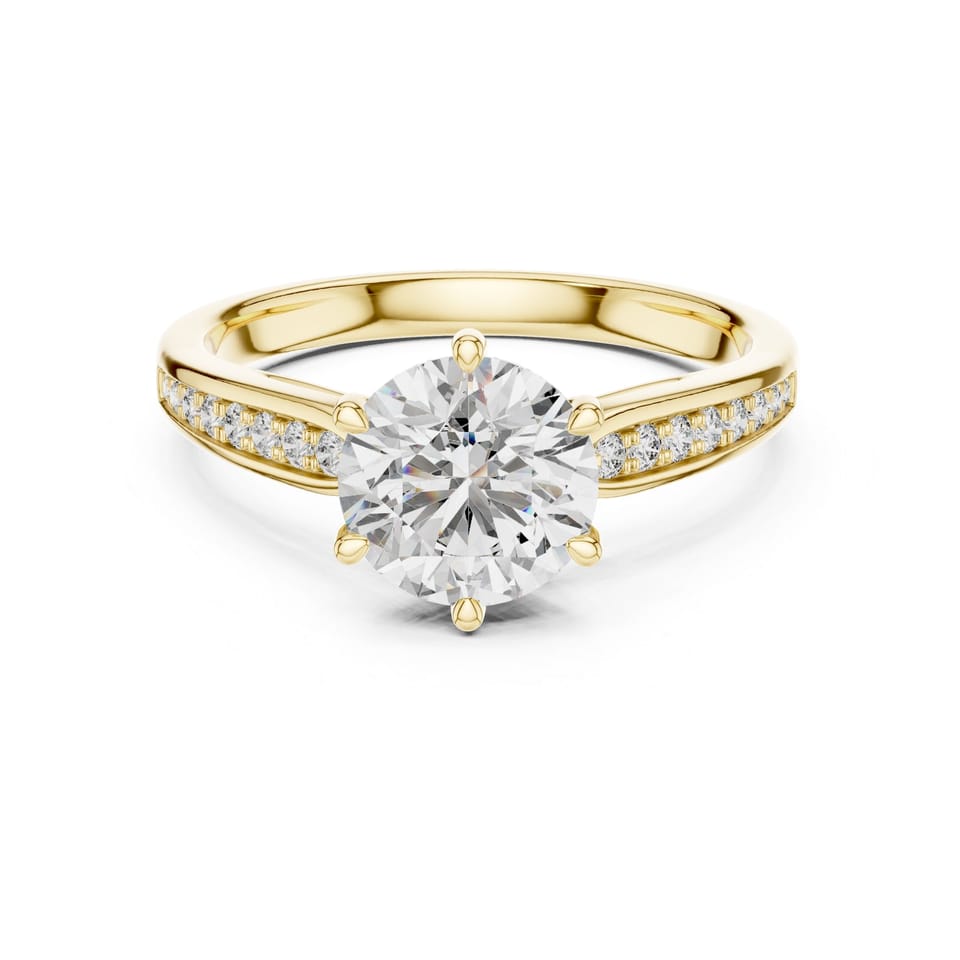
Round Laboratory-Grown Diamond Solitaire with Pavé Shoulders Engagement Ring, 1.00 ct
A 6.50 mm round, drawn for a 1.00 ct centre stone. IGI reports start above 1 carat, so at that weight it comes without one.
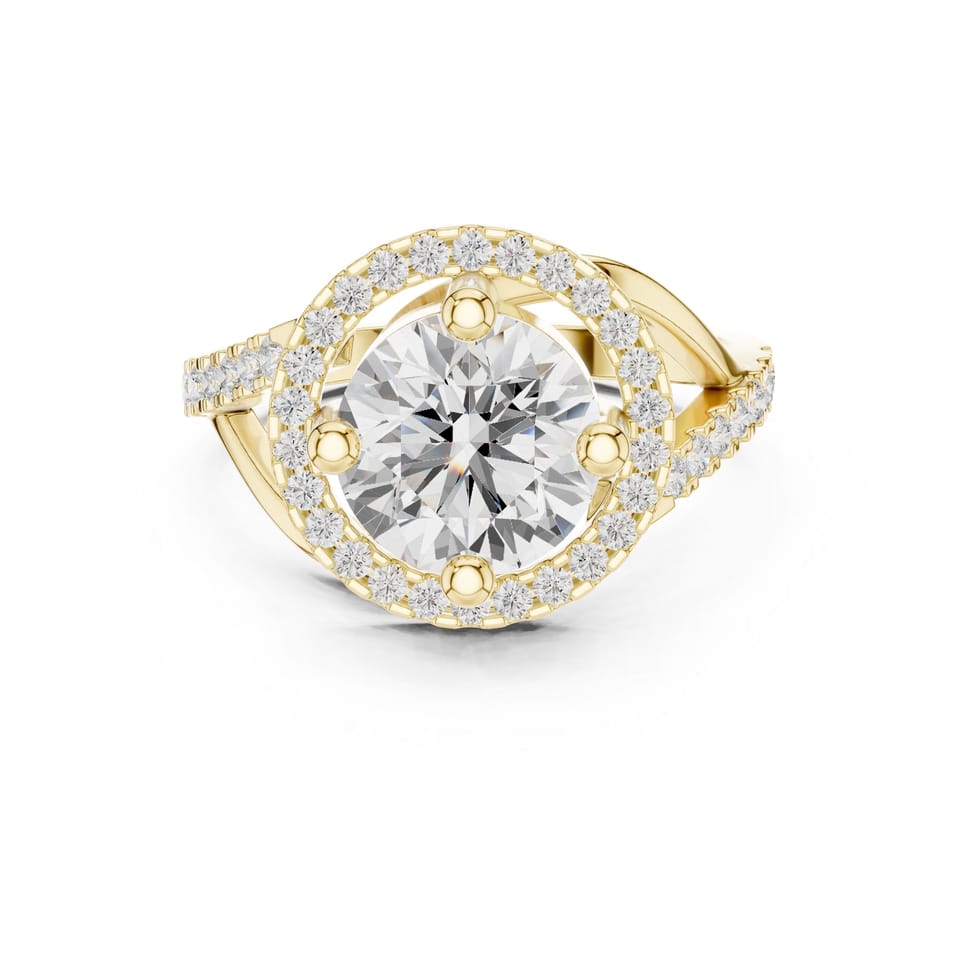
Laboratory-Grown Diamond Floating Halo Engagement Ring, 2.00 ct
An 8.00 mm round of 2.00 ct in an open halo, with 41 stones in all. Choose a laboratory-grown diamond and its IGI report travels in the box.
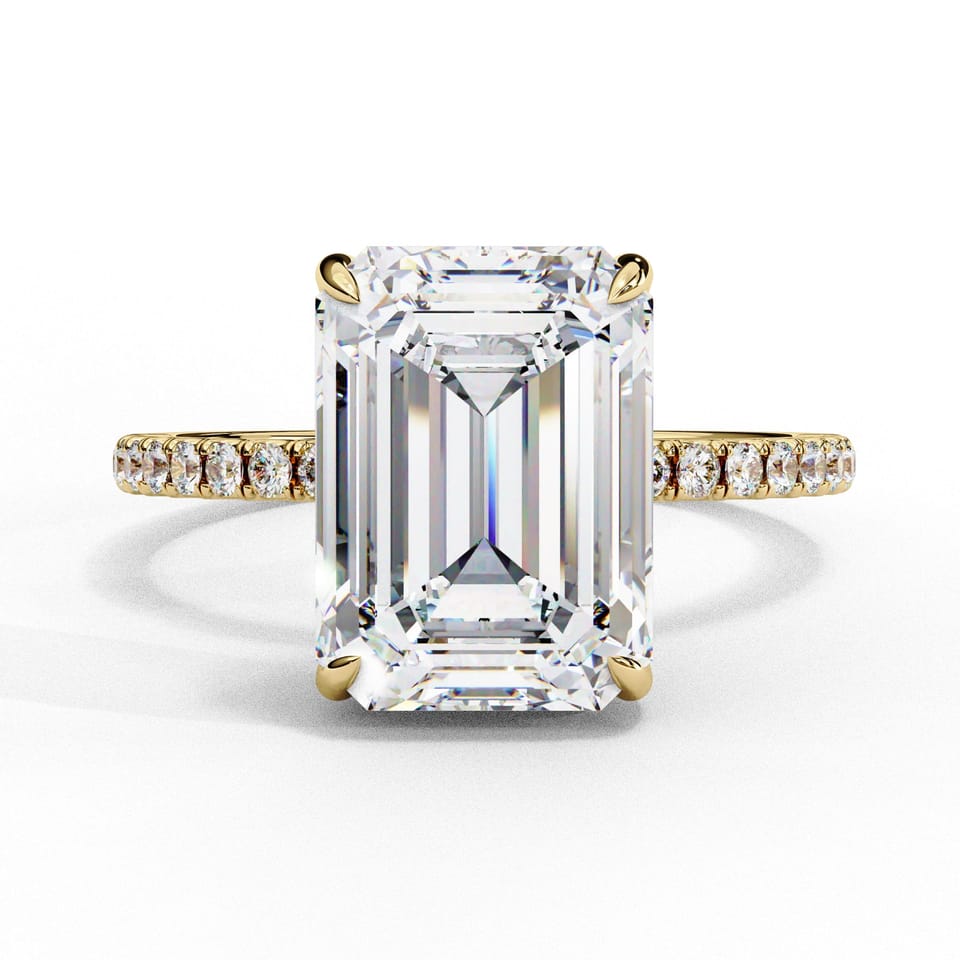
Emerald-Cut Laboratory-Grown Diamond Solitaire Engagement Ring, 2.56 ct
A 9.00 × 7.00 mm emerald cut of 2.56 ct on a pavé band, 35 stones in all. Choose a laboratory-grown diamond and its IGI report travels in the box.
Check yourself
Three questions. Tap one to see the answer.
Q1How long was it between Tennant’s paper and Hall’s run?
158 years and a day: from 15 December 1796 to 16 December 1954.
Q2Which method builds the crystal from a gas?
CVD, chemical vapour deposition. HPHT dissolves carbon in molten metal under great pressure instead.
Q3Does a 1.00 ct laboratory-grown diamond come with an IGI report from us?
Not at exactly 1.00 ct. An IGI report comes with every laboratory-grown main stone above 1 carat, so a stone of 1.01 ct or more comes with one.
Your progress is kept in this browser and isn’t sent to us.
Next in this path
Lesson 3: Laboratory-grown diamond or moissanite: which to choose
Read lesson 3- Laboratory-grown or mined diamond: what is actually different
- How the laboratory-grown diamond began: the morning of 16 December 1954You are here
- Laboratory-grown diamond or moissanite: which to choose
- VVS and VS clarity: what “very slightly included” looks likeComing later
- E and F colour: what “colourless” means on a reportComing later
- What an IGI report shows
- What decides the price of a laboratory-grown diamond ring
Quick answers
- Who made the first laboratory-grown diamond?
- H. Tracy Hall, a scientist at General Electric, on 16 December 1954, in a press of his own design called the belt. It was the first made by a reproducible process that others could verify. A team at ASEA in Stockholm had made crystals in February 1953 but did not report them; their result was announced only after GE’s, in 1955.
- When were gem-quality laboratory-grown diamonds first made?
- General Electric grew the first gem-quality crystals in 1970, by the high-pressure method, and reported them in 1971. By 2003, GIA’s journal Gems & Gemology was describing gem-quality crystals grown by CVD.
- What is the difference between HPHT and CVD?
- HPHT recreates conditions deep underground: carbon dissolved in molten metal crystallises on a seed at 5–6 gigapascals and 1,300–1,600 °C. CVD builds the crystal from methane and hydrogen in a low-pressure chamber at about 900–1,200 °C, over three or four weeks. An IGI report names the method used.
- What does Type IIa mean?
- That there is no measurable nitrogen in the crystal. The IGI report shown on our homepage, LG813625650, describes an 8.07 ct oval as “CVD grown, Type IIa”. Underground the type is rare: GIA reports that only about 1 per cent of mined diamonds are type II at all.
Ask us
A question this lesson didn’t answer?
Ask the people who set the stones. Send us a photo of a report, a size you’ve seen, or a design you have in mind, and we will tell you plainly what we know. We answer Monday to Saturday, 10am–7pm IST.
Monday to Saturday, 10am to 7pm India time. WhatsApp +91 70434 07831.
Buying for a shop or brand? See our trade terms · Trade WhatsApp +91 84607 61366
Sources
Nikunj Koshiya, Co-founder. Nikunj Koshiya and his brother Vishrut founded VIBHINI on 14 November 2025, building on three generations of their family’s manufacturing in Surat. Nikunj looks after sales and customer care.
- Smithson Tennant, “On the Nature of the Diamond”, Philosophical Transactions of the Royal Society, vol. 87, 1797; read 15 December 1796. Text
- Wikipedia, “Synthetic diamond”: ASEA, 16 February 1953; GE’s group of 1951; the belt’s pressures and temperatures; the 0.15 mm crystals; gem-quality crystals in 1970, reported in 1971; Eversole. Article
- National Inventors Hall of Fame, “H. Tracy Hall”: the reproducible experiment of 16 December 1954 in the belt. Page
- ASME, landmark: the ultra-high-pressure apparatus: the leaking press and rubber boots; 1,600 °C and 100,000 atmospheres. Page
- AIRAPT, “H. Tracy Hall (1920–2008)”: Hall’s own recollection of the morning. Page
- Wikipedia, “Moissanite”: Moissan’s find of 1893 and its identification in 1904. Article
- GIA, Gems & Gemology, Summer 2012: Eversole’s growth first documented in 1952; CVD below atmospheric pressure. Article
- GIA, Gems & Gemology, Winter 2003, Wang and others: gem-quality CVD crystals, Type IIa. Article
- GIA, Gems & Gemology, Summer 2024, Eaton-Magaña, Hardman and Odake: HPHT conditions and times; 80% of CVD stones treated after growth; type II at about 1% of mined stones. Article
- GIA, HPHT and CVD growth processes: CVD at about 900–1,200 °C over three or four weeks. Page
- GIA, on how mined and laboratory-grown stones differ: “essentially the same” properties. Article
- IGI, announcement of January 2021 that its laboratory-grown reports now state whether a stone is “as grown” or may have been treated. Page
- InStore, on IS 19469:2025 and the permitted terms, January 2026. Article
Our own facts come from the CADs of the pieces shown, our published policies, and IGI report LG813625650. If you know of a better source, tell us and we will check it. Facts checked 8 October 2026.