A Piece’s LifeNo. 1
Nineteen stones, one circle: the life of an emerald-cut eternity band
A full eternity band has no beginning, no end and no room for second thoughts. This is how ours goes from a column of figures to a ring on a hand, and what each step teaches about choosing one.
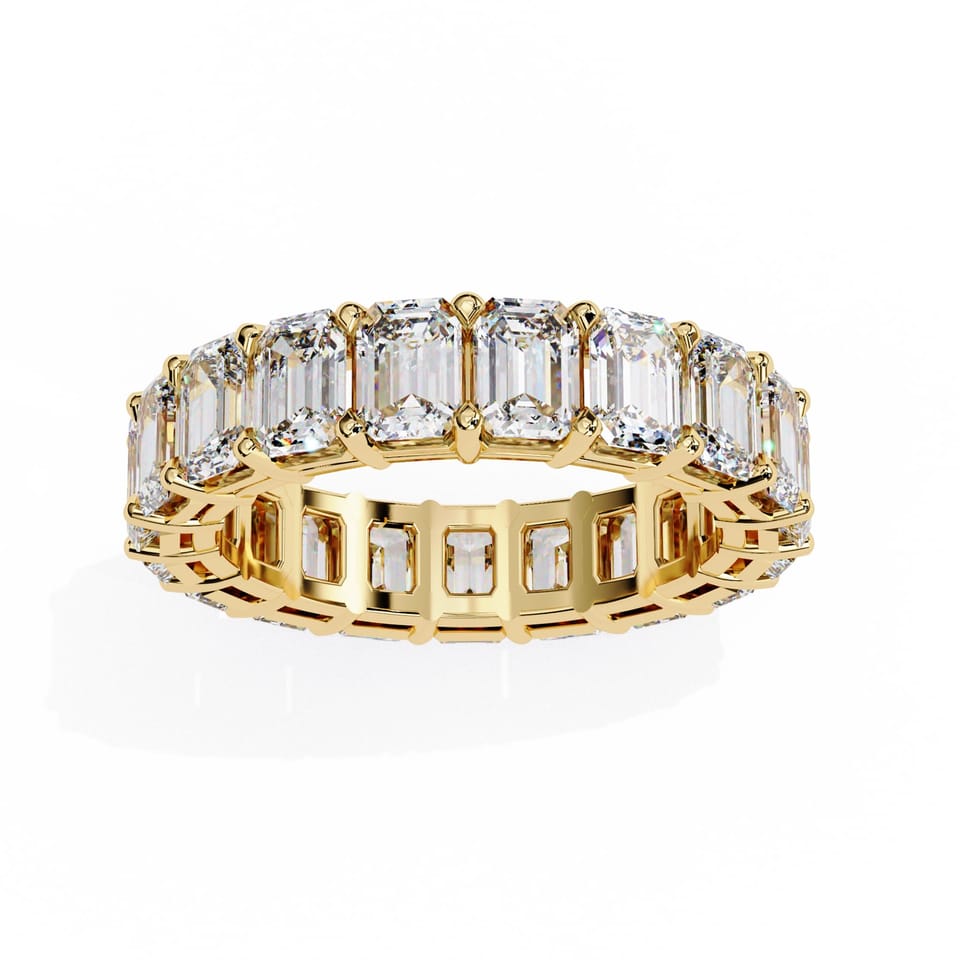
Our emerald-cut eternity band holds 19 emerald cuts of 4.50 × 3.25 mm, 4.88 ct of laboratory-grown diamond, all the way round. Every stone and every gram is known from the drawing before any gold is cast. Because the stones close the circle, the band is made in your size and can’t be resized afterwards.
It begins as a column of figures
Before there is any gold, there is a drawing. On the screen the band is a ring of 19 rectangles laid edge to edge, and beside it a column of figures the design program works out for itself: 19 emerald cuts, each 4.50 × 3.25 mm, 4.88 ct in all.
A carat is a fifth of a gram. It was fixed at exactly 200 milligrams in Paris in 1907, when the General Conference on Weights and Measures accepted the metric carat; the word itself travelled through Italian, Arabic and Greek from the carob seed. So these 19 stones together weigh 976 milligrams, just under a gram, and each is about a quarter of a carat.
The drawing weighs the metal too. It measures the volume of the band once, and multiplies that by the density of each alloy. That is why the same band is 3.42 g in 9K gold and 4.76 g in 18K. Nine-karat gold is nine parts gold in twenty-four; eighteen-karat is eighteen parts, twice as much, and gold is the heaviest metal in the mix. In 10K the band weighs 3.54 g, in 14K 3.98 g, and in silver 3.20 g. The metal in its price follows those grams at the day’s rate for that metal, which is why the price moves when gold does.
Why an emerald cut, and why it asks for clean stones
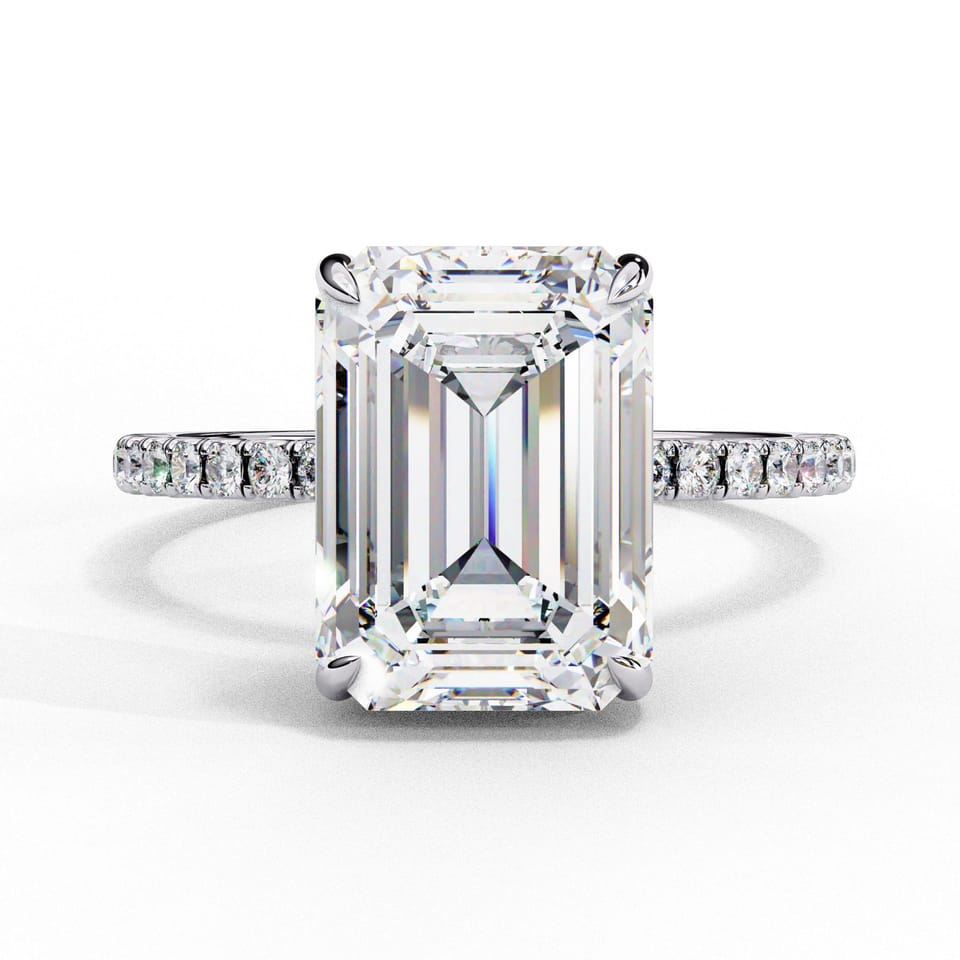
The emerald cut is a step cut: a broad, flat table framed by long, straight facets that fall away in rows like steps, with the corners cropped. It was first worked out for emeralds, a brittle stone, to ease the pressure of cutting and keep the corners from chipping, which is how it got its name.
- The table
- Rows of step facets
- Cropped corners
Its family is old. By the middle of the fifteenth century, cutters were grinding the point off an eight-sided crystal to make a flat top, the table cut, and the step cut keeps that broad, flat table at its centre. Its straight lines had their great moment in the Art Deco years, and they have never really left.
What a step cut gives is not a scatter of sparkle but depth. GIA calls the effect a “hall of mirrors”: long, open facets that draw the eye down into the stone. What it does not do is hide anything. Because the table is large and the facets are open, GIA notes that an emerald cut shows inclusions and colour more easily than other shapes, and GIA’s 4Cs blog suggests at least VS2 clarity and G colour.
Every laboratory-grown diamond we set is E to F colour and VVS to VS clarity, from a centre stone to the smallest stone in a pavé, and that includes all 19 here. In a band seen from every side, with nowhere for a weaker stone to sit unnoticed, it matters more than usual. Our guide to stone shapes compares the emerald cut with the oval, pear and radiant.
Why nineteen, and why your size comes first
An eternity band closes the circle with stones. Every ring on our website is priced in US size 6.5, 16.9 millimetres across the inside. Set with the long side across the finger, the drawing needs 19 stones to go all the way round.
- 19 stones
- A claw where each pair meets
That is the whole reason a full eternity band can’t be resized. Changing a ring’s size means working on its band, and every resize is work on the metal; here there is no plain metal to work on, because every part of the circle carries a stone. A different size is a different circle, worked out again in the drawing, which is why other sizes are made on request and quoted separately.
So we ask for your size before anything else, and we’ll help you measure if you aren’t sure. Our guide to finding your ring size at home shows how, and full, half and five-stone eternity rings are compared in the Journal.
Size first, stones second, gold third.
The order a full eternity band is decided in.From drawing to gold
In our workshop the design is drawn, the metal is cast and the stones are set, all in Surat. Casting metal to an exact shape is one of the oldest skills there is. In lost-wax casting, a wax model of the piece is enclosed in a heat-proof mould, the wax is melted out, and molten metal fills the space it leaves.
Among the oldest known examples are gold objects from the Varna necropolis in Bulgaria, made around 4500 BC. Closer to home, the bronze figure from Mohenjo-daro known as the Dancing Girl, found in 1926 and now in the National Museum in New Delhi, was cast the same way some four thousand years ago. A band like this asks of its gold what that bronze asked of its maker: to take the shape exactly. All 19 stones will sit in it, and every one of them depends on the metal being where the drawing says it is.
Nineteen stones, set by hand
Look closely at the band and you can see how it holds together. Where two stones meet, a single claw at each edge catches the cropped corners of both, so every claw does double work and very little metal shows between the stones. Underneath, the gallery is open, with a window below each stone.
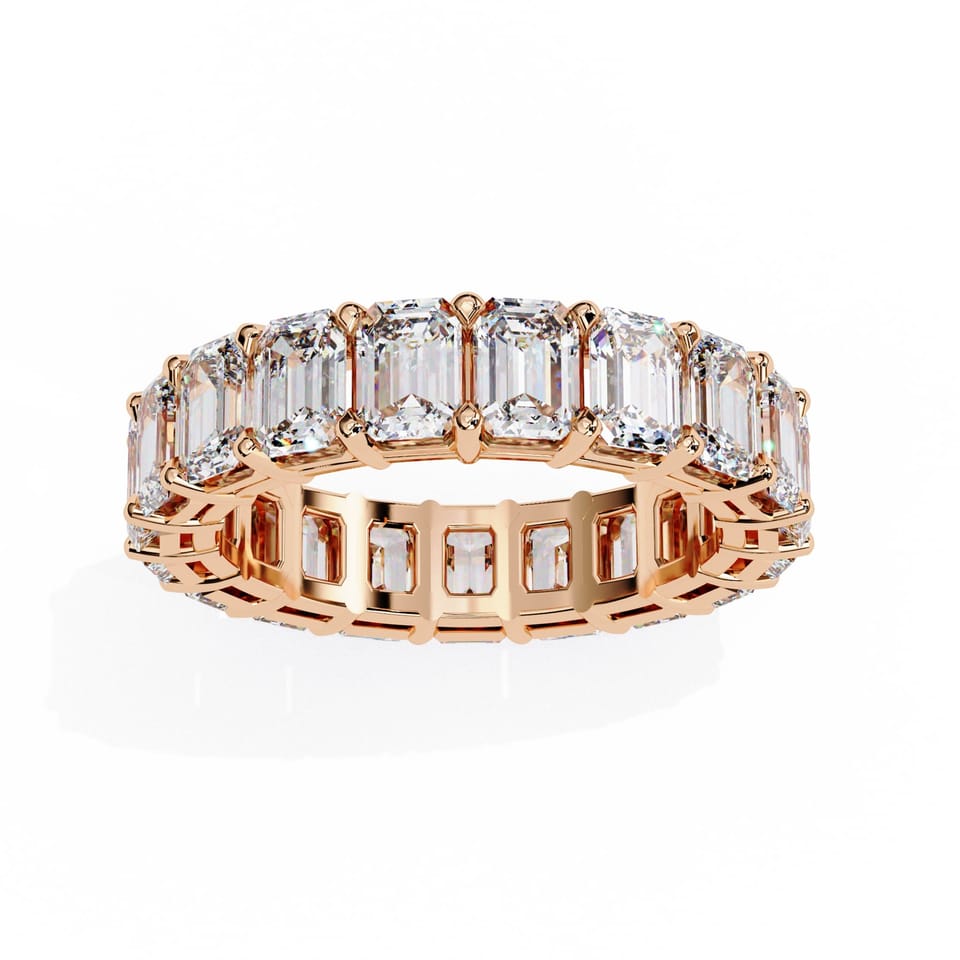
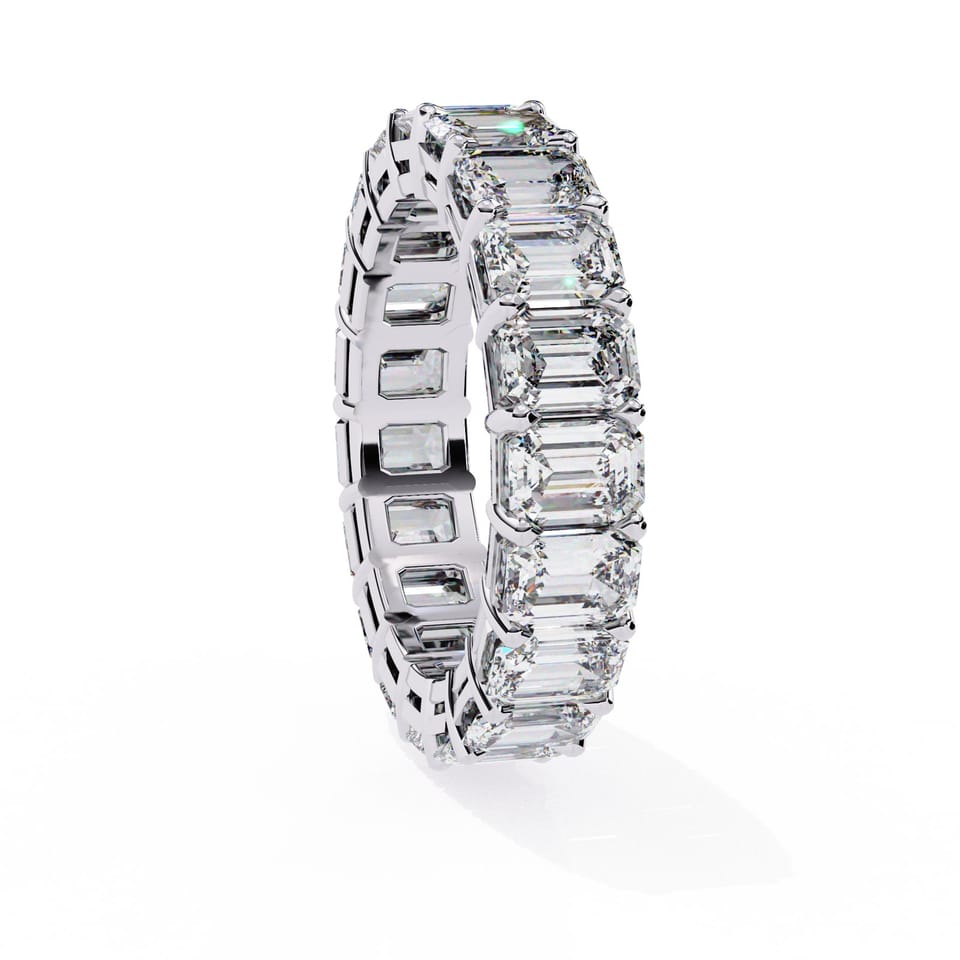
The stones are set by hand, and every piece is checked three times: at setting, at finishing, and again before it is packed.
Its portrait, then the post
When the band is finished, we photograph it and send you the photograph before it ships. We make that promise for every piece, and it matters most for one like this, paid for in full before it is made. Making takes about 15 days, counted from your approval and payment. Delivery is free and insured within India and takes 3 to 4 working days. Abroad it takes 8 to 10 working days, for a flat ₹7,500 with customs duty and import taxes included. You can cancel within 12 hours of ordering with nothing deducted, and return the band within 7 days of delivery, unworn and with its tag still attached.
You can also choose moissanite for the same design. It is a different stone, not a diamond, and it doesn’t come with an IGI report. Neither, as it happens, does the laboratory-grown version of this band: an IGI report comes with a laboratory-grown main stone above 1 carat, and each of these is about a quarter of one. Our comparison of the two stones goes further.
What the band teaches
If one thing carries over from this band to any ring you buy, let it be the order of things. Choose the size with care, because some designs, like this one, can’t be altered later. Ask for clean stones in a step cut, because it hides nothing. Then choose the gold for its colour and its weight in the hand, knowing that the karat changes the grams and the price, never the shape.
Quick answers
- Where does the emerald cut get its name?
- From the emerald, the stone it was first worked out for. Emeralds are brittle, and this step cut, with its corners cropped, eased the pressure of cutting and kept the corners from chipping.
- How many stones are in VIBHINI’s emerald-cut eternity band?
- It holds 19 emerald cuts of 4.50 × 3.25 mm, 4.88 ct in all in laboratory-grown diamond, held by shared claws all the way round, as its CAD draws them.
- Why does an emerald cut need high clarity?
- Its large table and long, open facets show inclusions and colour more easily than most shapes. Every laboratory-grown diamond we set is E to F colour and VVS to VS clarity, including the smallest.
- How much gold is in the band?
- From its CAD: 3.42 g in 9K, 3.54 g in 10K, 3.98 g in 14K and 4.76 g in 18K gold, or 3.20 g in silver. The shape is the same in every metal; only the weight changes.
Ask us
Would you like this band in your size?
Tell us your ring size, or ask us to help you measure. You deal with Nikunj and Vishrut directly, on WhatsApp or by email.
Monday to Saturday, 10am to 7pm India time. WhatsApp +91 70434 07831.
Buying for a shop or brand? See our trade terms · Trade WhatsApp +91 84607 61366
Sources
Nikunj Koshiya, Co-founder. Nikunj Koshiya and his brother Vishrut founded VIBHINI on 14 November 2025, building on three generations of their family’s manufacturing in Surat. Nikunj looks after sales and customer care.
- VIBHINI: the CAD record of design VR260100 (stones, carats, metal weights) and the published pages About (the design drawn, the metal cast and the stones set in Surat, and every piece checked at setting, at finishing and again before it is packed), Resizing & Care and Shipping & Returns.
- GIA 4Cs blog, its article on the elegance of the emerald cut: developed for emeralds to reduce pressure in cutting and prevent chipping; the “hall of mirrors”; at least VS2 clarity and G colour. 4cs.gia.edu
- GIA 4Cs blog, its emerald-cut buying guide: long, rectangular facets make inclusions easier to see. 4cs.gia.edu
- Australian Museum, “Cutting gemstones”: the emerald cut as a truncated step cut that protects fragile corners. australian.museum/Cutting-gemstones
- Wikipedia, its article on cuts and their history: the table cut by the mid-15th century; the step cut in the Art Deco period. en.wikipedia.org
- Wikipedia, “Carat (mass)”: the 200 mg metric carat, accepted in Paris in October 1907; the word’s origin. en.wikipedia.org/wiki/Carat_(mass)
- Wikipedia, “Lost-wax casting”: the Varna gold, 4550–4450 BC. en.wikipedia.org/wiki/Lost-wax_casting
- Wikipedia, “Dancing Girl (prehistoric sculpture)”: c. 2300–1750 BC, lost-wax cast, excavated in 1926, National Museum, New Delhi. en.wikipedia.org/wiki/Dancing_Girl_(prehistoric_sculpture)
Every date and figure in this story comes from the sources above. If you know of a better one, tell us and we will check it. Facts checked 8 October 2026.