The Cover StoryStories in Stone, part 2 of 8
Dhanteras: why gold is bought on the thirteenth day
On the thirteenth day of the waning moon before Diwali, many families in India bring home something of gold or silver. Where the custom comes from: a physician of the gods who rose from the ocean with a jug of nectar, a lamp lit at the door for Yama, and a goddess who is welcomed home with gold.
A date set by the moon
Dhanteras takes its name from its date. Dhan is wealth and teras is thirteen: the festival falls on the trayodashi, the thirteenth lunar day, of the fortnight in which the moon wanes towards the new moon of Diwali. Its Sanskrit name, Dhanatrayodashi, says the same at greater length. It opens Diwali’s five days, which run from Dhanteras to Bhai Dooj.
A lunar day doesn’t keep to the solar calendar, so Dhanteras moves from year to year. In 2026 the trayodashi begins in Surat at 10:30 in the morning of Friday 6 November and ends at 10:47 the next morning. The day’s puja belongs to the evening, the pradosh kaal after sunset, and it is on Friday evening that the trayodashi is under way, which makes Friday the day.
A physician with a jug of nectar
Dhanvantari’s story is told in the Bhagavata Purana, though its chapter on the churning never names Dhanteras. Gods and demons churn the Ocean of Milk for amrita, the nectar of immortality, and one after another its wonders rise from the water. Partway through comes Ramā, the goddess of fortune, whom India knows best as Lakshmi. At last appears a strongly built man in yellow garments and pearl earrings who carries, in one English translation, “a jug filled to the top with nectar”. He is Dhanvantari, and the purana says he was very conversant with the science of medicine.
Dhanteras is kept as his birthday, Dhanvantari Jayanti, and he is honoured as the god of Ayurveda. Modern India gave the day a use of its own. The first National Ayurveda Day was held on Dhanvantari Jayanti, 28 October 2016, and the ninth on 29 October 2024. In 2025 the government fixed Ayurveda Day on 23 September instead, because Dhanteras moves so much: over the coming decade it falls anywhere between 15 October and 12 November.
A lamp for Yama
A second story belongs to the evening, and it is told as a tale. A king named Hima had a son of sixteen whose horoscope said he would die of a snakebite on the fourth day of his marriage. When the day came, the prince’s young wife would not let him sleep. She heaped her ornaments and her gold and silver coins at the door of their room, lit lamps all around it, and told stories and sang through the night. Yama, the god of death, came in the form of a serpent, but the light on the gold dazzled him. He climbed the heap, sat there listening until morning, and went away without the prince.
The same thirteenth day still has its lamp for Yama. The Yama Deepam is lit outside the home to ward off an untimely death in the family, and in Drik Panchang’s calendar for Surat it falls on Friday 6 November 2026, with Dhanteras itself.
Gold heaped at the door and lamps burning until dawn: in the tale of the day, it was gold and light that kept death waiting.
Why gold, and why that day
On the trayodashi Lakshmi is worshipped with Kubera, the god of riches. Drik Panchang likens buying gold during Diwali to inviting Lakshmi into the home, and ranks Dhanteras with Akshaya Tritiya as a day to buy it; Prokerala, another panchang, calls gold and silver bought on Dhanteras a sign of welcoming the goddess. Read beside the tale of Hima’s son, the custom has two sides, one hopeful and one protective: gold to bring fortune in, and gold and light to keep misfortune at the door.
The season keeps other gold days besides. Drik Panchang also favours the Pushya nakshatra for buying gold before Diwali. In 2026 it falls on Sunday 1 November, a Ravi Pushya, as Pushya on a Sunday is called.
New books for a new year
In Gujarat the festival runs longer. Here, Drik Panchang notes, Diwali begins two days early, on Agyaras, and ends on Labh Pancham. It is the turn of the trading year as well. Traditional account books in Gujarat are called chopda, and on Diwali itself, Sunday 8 November 2026, new ones are sanctified in the Chopda Puja, to ask a blessing on a profitable year to come.
The Gujarati new year follows, on Tuesday 10 November in Drik Panchang’s calendar for Surat. On Labh Pancham, Saturday 14 November, most shops and businesses open again and begin their new ledgers, the khatu. Surat’s own story, from Mughal port to cutting city, comes next in this series.
Dhanteras, in figures
A festival set by the moon
- 13The lunar day: trayodashi, the thirteenth of the waning fortnight
- 5Diwali’s days, from Dhanteras to Bhai Dooj
- 8.8.33The verse of the Bhagavata Purana in which Dhanvantari carries his jug of nectar
- 2016The year India first held National Ayurveda Day on Dhanvantari Jayanti
From Prokerala and Drik Panchang for the calendar, the Śrīmad-Bhāgavatam (canto 8, chapter 8) for the verse, and the Press Information Bureau, 28 October 2016, for Ayurveda Day.
In gold
Old shapes, in gold
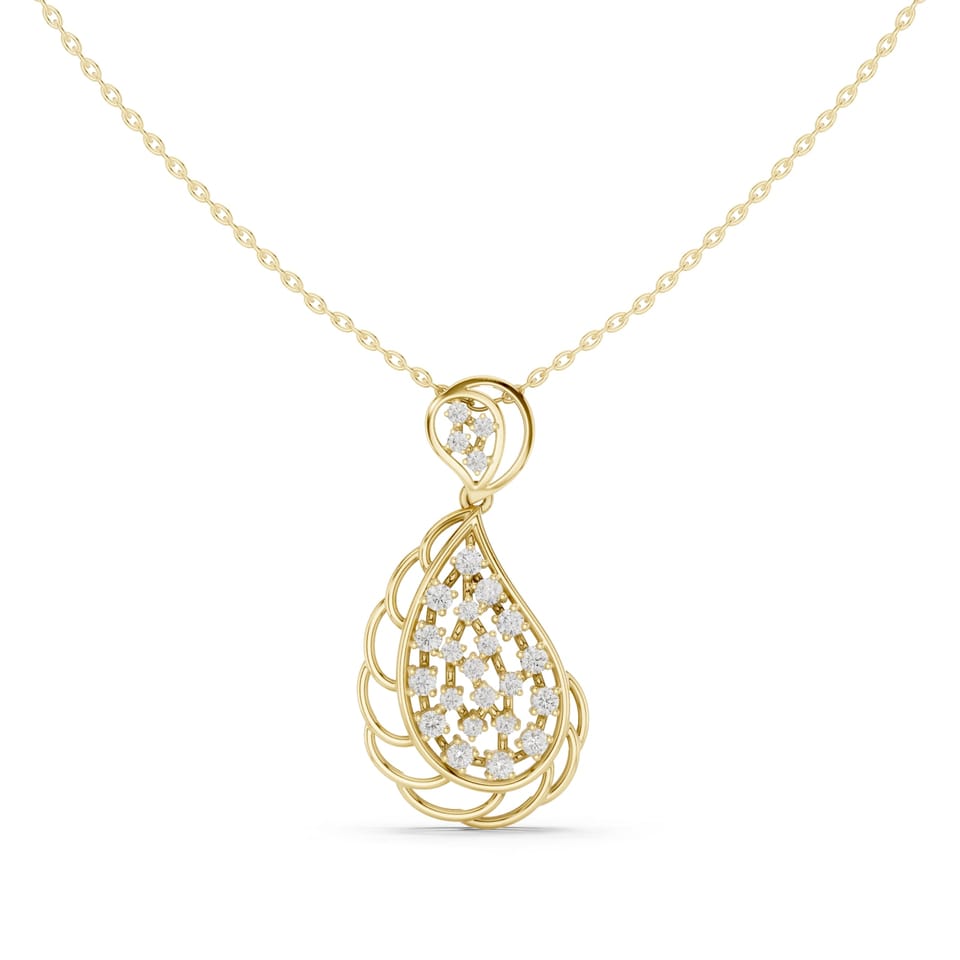
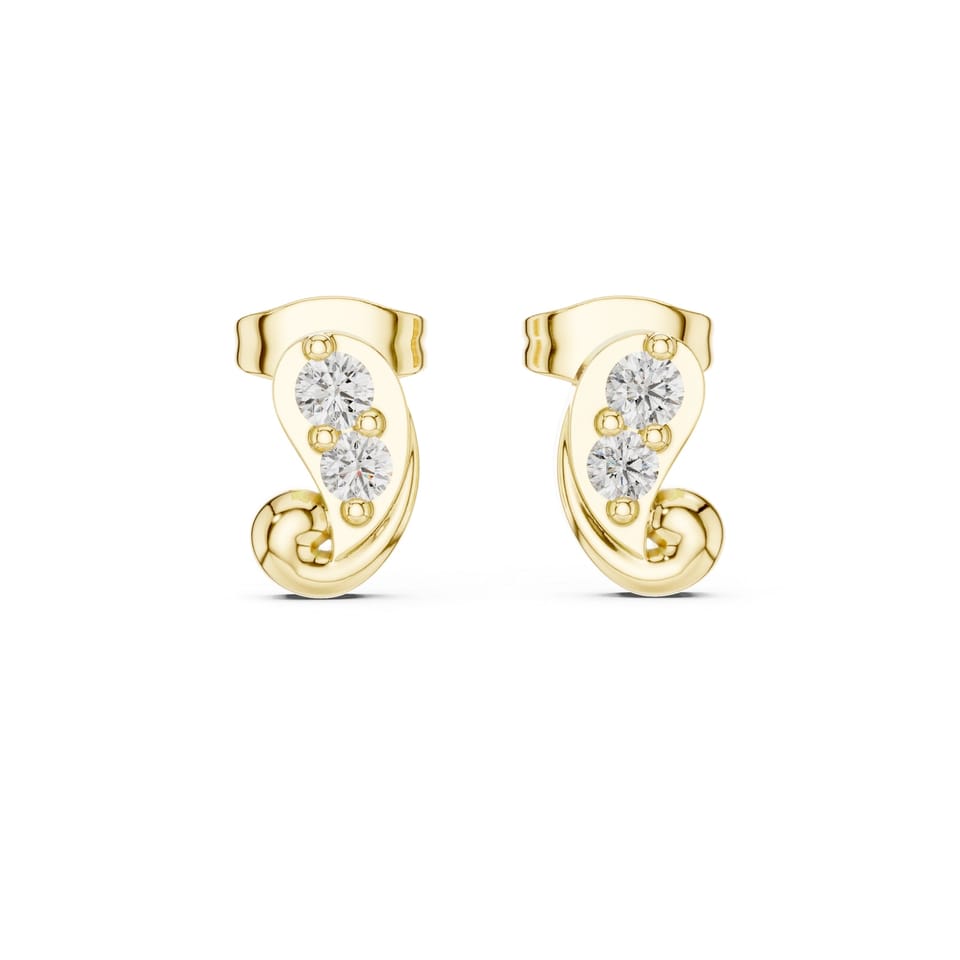
The paisley is older than its English name. In India it is the buta, in Persian the boteh, a curved teardrop that Kashmir’s weavers wove into their shawls; it is called paisley after the Scottish town of Paisley, which in the first half of the nineteenth century became famous for its imitations of those shawls. The palmette, a fan of palm leaves, is older still, and India carved it on the stone pillars of the emperor Ashoka in the third century BC.
Each of these three is drawn in CAD, made to order in our workshop in Surat and photographed before it ships to you. Each can be made in silver with a rhodium or gold plating, or in 9K, 10K, 14K or 18K gold in yellow, white or rose, set with laboratory-grown diamonds or with moissanite, which is a different stone and not a diamond. The figures below come from each design’s CAD.
Laboratory-Grown Diamond Paisley Scatter Pendant, 0.64 ct total
A scatter of stones claw-set across an openwork lattice inside a paisley of gold, and a smaller, stone-set paisley at the bail: 25 stones in all.
- Stones
- 7 round stones, 1.60 mm; 12 round stones, 2.00 mm; 6 round stones, 1.50 mm; 0.64 ct in all
- Gold
- 3.51 g in 9K to 4.82 g in 18K
- Silver
- 3.28 g
- Chain
- Priced without a chain; ask us about one
Laboratory-Grown Diamond Paisley Two-Stone Stud Earrings, 0.23 ct total
4 stones on the pair, claw-set down a paisley of polished gold that ends in a curl.
- Stones
- 2 round stones, 2.30 mm; 2 round stones, 2.50 mm; 0.23 ct for the pair
- Gold
- 2.24 g in 9K to 3.08 g in 18K, for the pair
- Silver
- 2.10 g, for the pair
- Sold as
- A pair
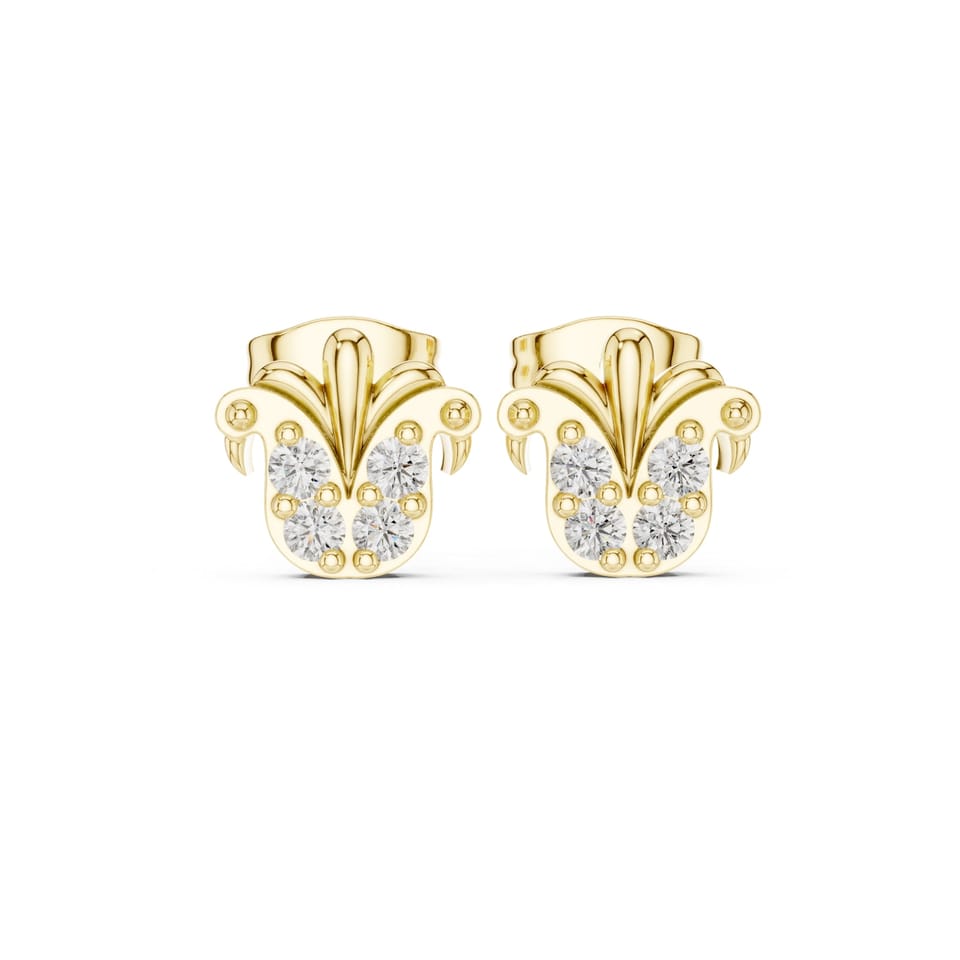
Laboratory-Grown Diamond Palmette Cluster Stud Earrings, 0.28 ct total
8 stones on the pair, claw-set beneath a fan of gold leaves: a palmette in polished gold.
- Stones
- 8 round stones, 2.00 mm; 0.28 ct for the pair
- Gold
- 2.10 g in 9K to 2.88 g in 18K, for the pair
- Silver
- 1.96 g, for the pair
- Sold as
- A pair
Each piece is made to order in about 15 days, photographed when it is finished, and the photograph sent to you before it ships. Delivery is free within India; abroad it is a flat ₹7,500 with duties included. You can cancel free within 12 hours of ordering, and return a piece within 7 days of delivery, unworn and with its tag still attached; return shipping is yours to pay.
Pictures are renders made from each design’s CAD. Your own piece is photographed at the bench before it ships, so you see exactly what is coming.
What the day keeps
Set the shopping aside and Dhanteras still holds three old ideas side by side: health, in Dhanvantari and his jug of nectar; life, in a lamp lit against an untimely death; and fortune, in Lakshmi and the gold brought home for her. The metal is the part everyone sees. The stories are the reasons given for buying it on that day, and not on another.
Next in Stories in Stone
The eight parts of Stories in StoneFrom the Journal
Quick answers
- Why is gold bought on Dhanteras?
- Because Lakshmi, the goddess of wealth, is worshipped on it with Kubera, and gold or silver brought home that day is held to welcome her in. Drik Panchang ranks Dhanteras with Akshaya Tritiya as a day to buy gold. A tale told of the day adds another reason: gold heaped at a door, with lamps lit around it, once kept Yama from a young prince until morning.
- What does the word Dhanteras mean?
- Dhan means wealth and teras means thirteen: the festival falls on the trayodashi, the thirteenth lunar day of the waning fortnight before Diwali. It is also called Dhanatrayodashi, and it is kept as Dhanvantari Jayanti, the birthday of the god of Ayurveda.
- When does Dhanteras fall?
- On the trayodashi of the waning moon before Diwali, so its date changes every year. In 2026 it is Friday 6 November; in Surat the lunar day runs from 10:30 in the morning on the 6th to 10:47 in the morning on the 7th. Over the coming decade it falls anywhere between 15 October and 12 November.
- Who is Dhanvantari?
- The physician of the gods and the god of Ayurveda. In the Bhagavata Purana he rises from the churning of the Ocean of Milk carrying a jug of nectar. Dhanteras is kept as his birthday, and from 2016 to 2024 India held its National Ayurveda Day on it.
- Why is a lamp lit for Yama on Dhanteras?
- To ward off an untimely death in the family. The Yama Deepam is lit outside the home on the same thirteenth day, and a tale told of the day explains it: the wife of King Hima’s son kept him awake with lamps and a heap of gold, and Yama, who had come as a serpent, sat dazzled on the gold until morning.
Ask us
A question about gold, or a design in mind?
Write to us on WhatsApp, by email or through the enquiry form. Tell us the piece or the shape you have in mind, in gold or in silver. On WhatsApp the message opens already written, naming this story, so you only need to add your question.
Monday to Saturday, 10am to 7pm India time. WhatsApp +91 70434 07831.
Buying for a shop or brand? See our trade terms · Trade WhatsApp +91 84607 61366
Sources
Nikunj Koshiya, Co-founder. Nikunj Koshiya and his brother Vishrut founded VIBHINI on 14 November 2025, building on three generations of their family’s manufacturing in Surat. Nikunj looks after sales and customer care.
- Drik Panchang, “2026 Dhantrayodashi | Dhanteras Puja Date and Timings for Surat, Gujarat, India”: Dhanteras on Friday 6 November 2026; the trayodashi from 10:30 am on 6 November to 10:47 am on 7 November in Surat; the puja held in the pradosh kaal after sunset, while the trayodashi prevails; the first of Diwali’s five days; Dhanvantari Jayanti, the birth anniversary of the god of Ayurveda; Lakshmi and Kubera worshipped on the trayodashi; the Yama Deepam lamp lit outside the home against an untimely death. drikpanchang.com
- Drik Panchang, “2026 Diwali Puja Calendar, Deepavali Puja Calendar for Surat, Gujarat, India”: Dhanteras and the Yama Deepam on 6 November, Diwali and the Chopda Puja on Sunday 8 November, the Gujarati new year on Tuesday 10 November and Bhai Dooj on 11 November 2026; Diwali’s five days, from Dhanteras to Bhai Dooj; in Gujarat the festival beginning on Agyaras and ending on Labh Panchami. drikpanchang.com
- Drik Panchang, “2026 Auspicious Time to Buy Gold during Diwali - Dhanteras and Pushya Nakshatra days”: Dhanteras ranked with Akshaya Tritiya for buying gold; buying gold during Diwali likened to inviting Lakshmi into the home; the Pushya nakshatra favoured for buying gold before Diwali; the Ravi Pushya of Sunday 1 November 2026. drikpanchang.com
- Drik Panchang, “2026 Chopda Pujan Shubh Muhurat and timings for Surat, Gujarat, India”: account books called chopda in Gujarat, and new ones sanctified in the Chopda Puja on Diwali, Sunday 8 November 2026. drikpanchang.com
- Drik Panchang, “2026 Labh Pancham | Labh Panchami date and time for Surat, Gujarat, India”: Labh Pancham on Saturday 14 November 2026, the end of Gujarat’s Diwali, when most shops and businesses start again and open new ledgers, called khatu. drikpanchang.com
- Prokerala, “Dhanteras 2026 | Dhanteras Shubh Muhurat & Puja Timing”: dhan, wealth, and teras, thirteenth; the trayodashi of the waning fortnight; Friday 6 November 2026; gold and silver bought as a sign of welcoming Lakshmi; Dhanteras on 29 October in 2024. prokerala.com
- Bhaktivedanta Book Trust, Śrīmad-Bhāgavatam, canto 8, chapter 8, “The Churning of the Milk Ocean”, on Vedabase: Ramā, the goddess of fortune, rising from the ocean (8.8.8); Dhanvantari, strongly built, in yellow garments and pearl earrings, carrying a jug of nectar, and versed in medicine (8.8.31–35). vedabase.io
- Wikipedia, “Dhanteras”: the name Dhanatrayodashi; Dhanvantari, the physician of the gods, rising from the churning of the ocean with a pot of amrita; the tale of King Hima’s son, for which it cites William D. Crump, Encyclopedia of New Year’s Holidays Worldwide (McFarland, 2016), p. 112. en.wikipedia.org
- Press Information Bureau, Ministry of AYUSH, “First Ever National Day of Ayurveda being celebrated throughout the country today”, 28 October 2016: the first National Ayurveda Day, held on Dhanwantari Jayanti. pib.gov.in
- Press Information Bureau, Prime Minister’s Office, release of 28 October 2024 “On the occasion of Dhanvantari Jayanti and 9th Ayurveda Day”: the ninth Ayurveda Day, on 29 October 2024. pib.gov.in
- Akashvani News (News On AIR), “Govt declares 23rd September as Ayurveda Day”, 14 May 2025: Ayurveda Day moved from Dhanteras to 23 September, because over the coming decade Dhanteras falls anywhere between 15 October and 12 November. newsonair.gov.in
- Shahzeen Nasim, “Kashmir to Paisley”, Cooper Hewitt, Smithsonian Design Museum, 29 July 2016: the motif called boteh in Persian and buta in the Indian subcontinent, and named in English after the Scottish town of Paisley, famous for its imitation shawls in the first half of the nineteenth century. cooperhewitt.org
- Wikipedia, “Palmette”: a motif like the fan-shaped leaves of a palm, first found in ancient Egypt, and the flame palmette carved on the Pillars of Ashoka in the third century BC. en.wikipedia.org
- VIBHINI design records for VP262003, VE262011 and VE262044: stone shapes, sizes and weights, settings and metal weights, read from each design’s CAD.
Every date and figure in this story comes from the sources above. If you know of a better one, tell us and we will check it. Facts checked 12 October 2026.