A Piece’s LifeNo. 2
137 ovals on their sides: the life of an east-west tennis necklace
A tennis necklace is one idea, repeated: a stone, a link, a stone. Ours turns every oval on its side. This is how it goes from one oval drawn in CAD to a line of 137 round the neck, and what each step shows about a necklace of stones.
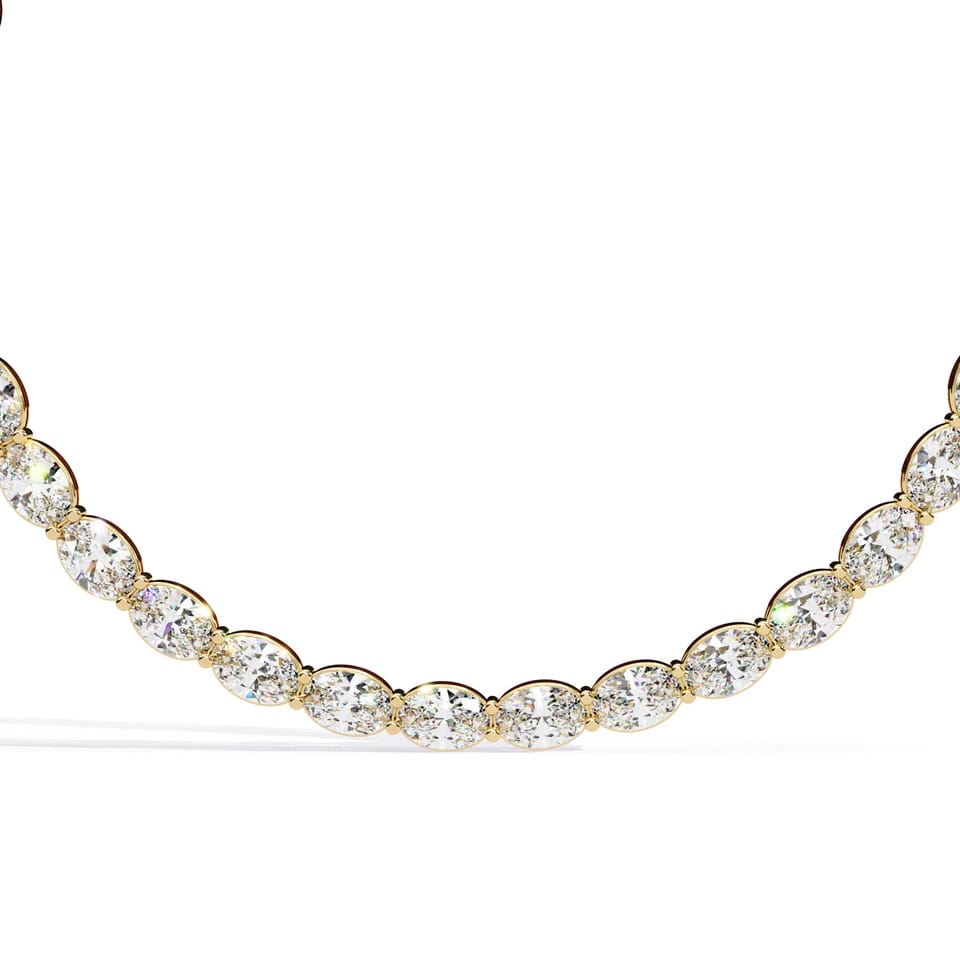
Our east-west tennis necklace is one line of 137 ovals of 3.00 × 2.00 mm, 6.20 ct of laboratory-grown diamond in all, each turned on its side and held by claws in an open basket of its own. Every stone and every gram is known from the drawing before any metal is cast.
It begins as one oval
Before there is any gold, there is a drawing. On the screen the necklace is a line of 137 ovals, every one of them 3.00 × 2.00 mm, and beside it a column of figures the design program works out for itself: 6.20 ct in all, about 0.05 ct a stone.
A carat is 200 milligrams, so the 137 stones together weigh 1,240 milligrams, spread along the whole length of the necklace. Where the metric carat came from is told in the life of our eternity band.
Small as they are, they are held to the same grade as a centre stone. Every laboratory-grown diamond we set is E to F colour and VVS to VS clarity, from a centre stone to the smallest stone in a line, and that includes all 137 here.
Why turn an oval on its side
An oval has a long way and a short way. On a ring, GIA’s guide to the oval cut describes an east-west oval as one set horizontally across the finger, rather than pointing along it. Our necklace gives every oval the same quarter turn, so each one’s length lies along the line and the stones follow one another tip to tip.
That is what the front of the necklace shows: an unbroken line of ovals, each wider than it is tall as you face it, running from one side to the other.
The shape is older than its modern cut. GIA notes that ovals were among the shapes cut once the brilliant style appeared, around 1700, but that books on gems began to name the oval as a shape only in the late 1800s. It dates the modern oval brilliant to 1957, when the cutter Lazare Kaplan developed a design of 58 facets with the sparkle of a round brilliant. How the oval sits beside the emerald cut, the pear and the radiant is in our guide to stone shapes.
A link for every stone
Look closely at the front and you can see how the line holds together. Each oval sits inside a thin rim of metal, and wherever two meet, a pair of small round-headed claws stands at the join, one above the line and one below it, between one oval and the next.
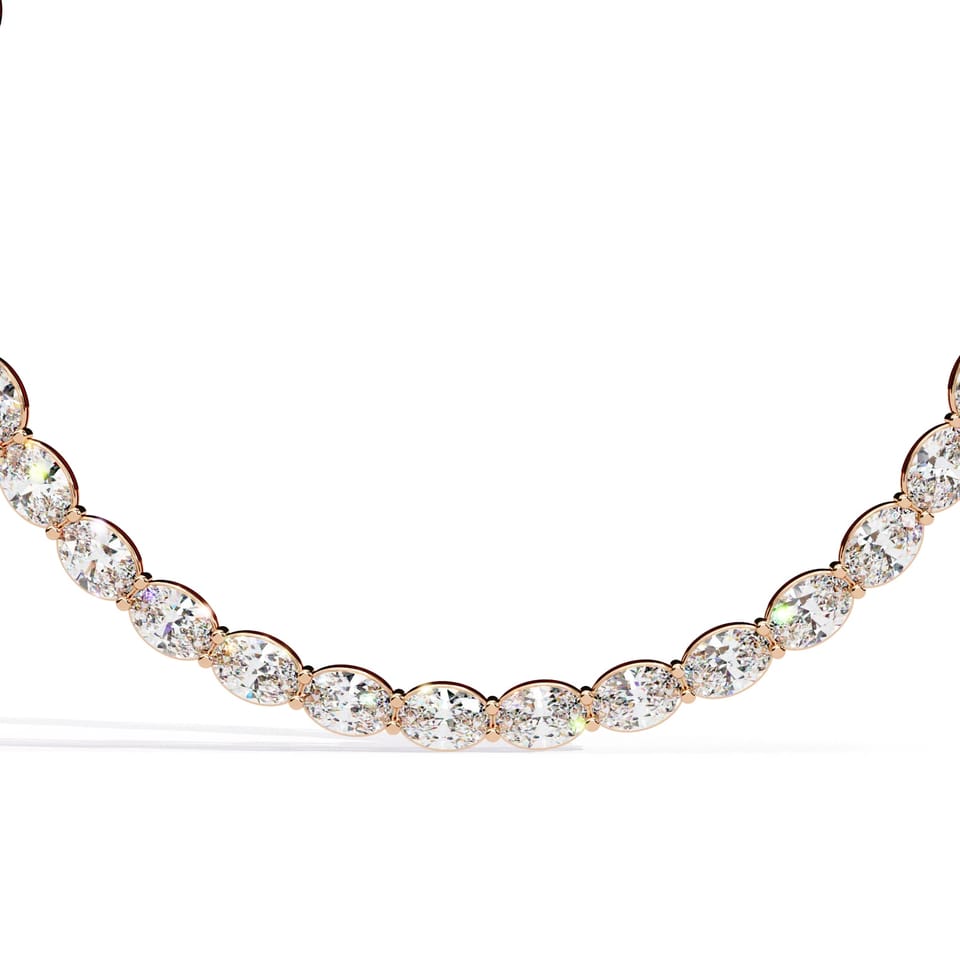
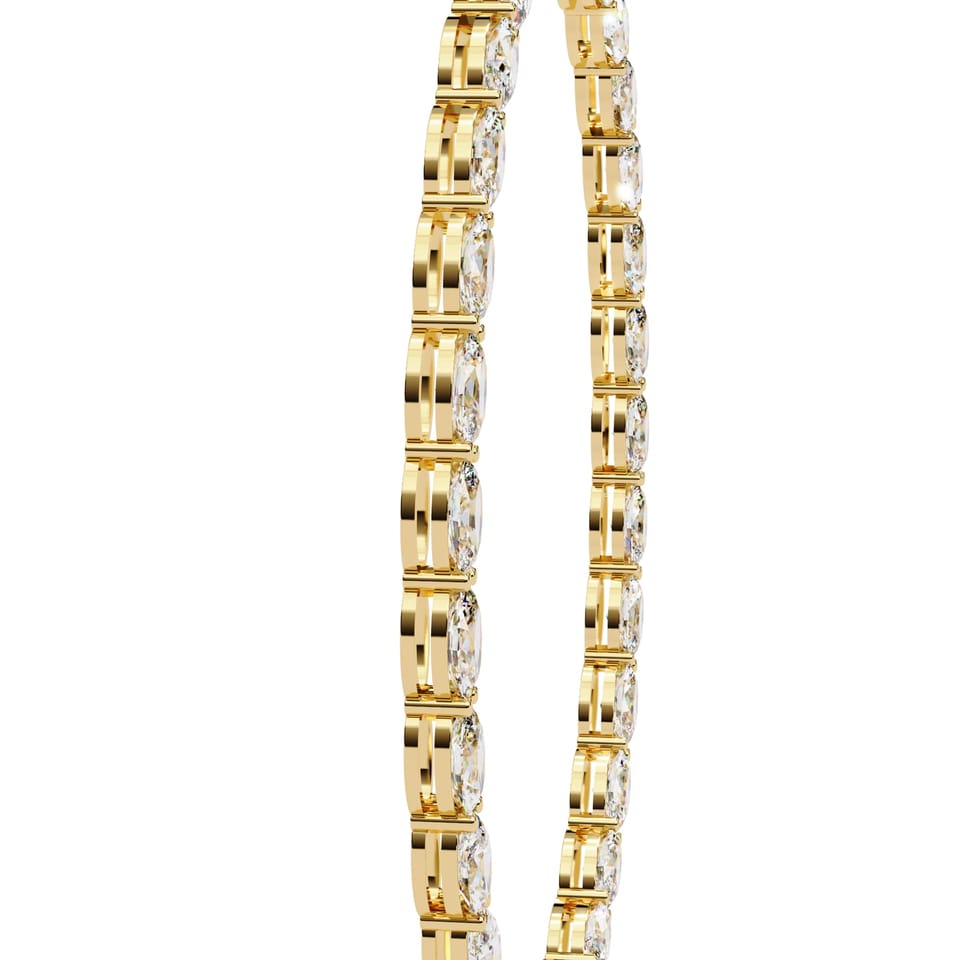
Seen from the side, every stone has a frame of its own, joined to the next where the claws stand. That is what makes it a tennis necklace rather than a solid collar: with a link for every stone, the line can bend at every join. The renders show it both ways, following a curve at the front and laid flat in a circle.
The word “tennis” has a story of its own, which comes later in Stories in Stone.
The open basket
Turn the necklace on its edge and the frame under each oval shows. Below the rim, two flat rails run along the line with an open window between them, and the claws rise from a cross-bar at every join. Under each stone there is no closed cup of metal, only that window.
Jewellers call an open frame like this a basket. Ganoksin’s lesson on making one describes the basket as an open-wire design that uses very little metal and lets light enter the stone from all angles. How it compares with other ways of holding a stone is in settings explained.
One closed line
Laid down, the necklace closes into a circle of 137 ovals, with no larger stone at the centre and no plain chain at the back: the same stone, in the same basket, all the way round to the small clasp that closes it.
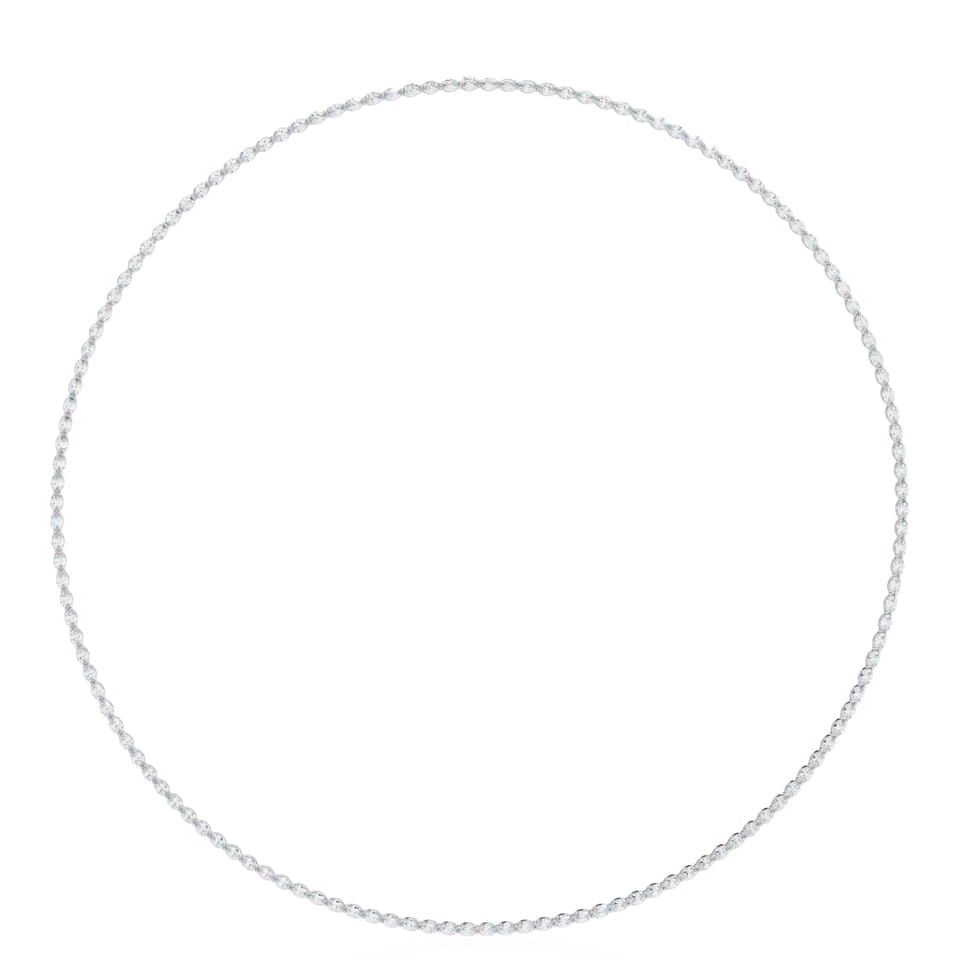
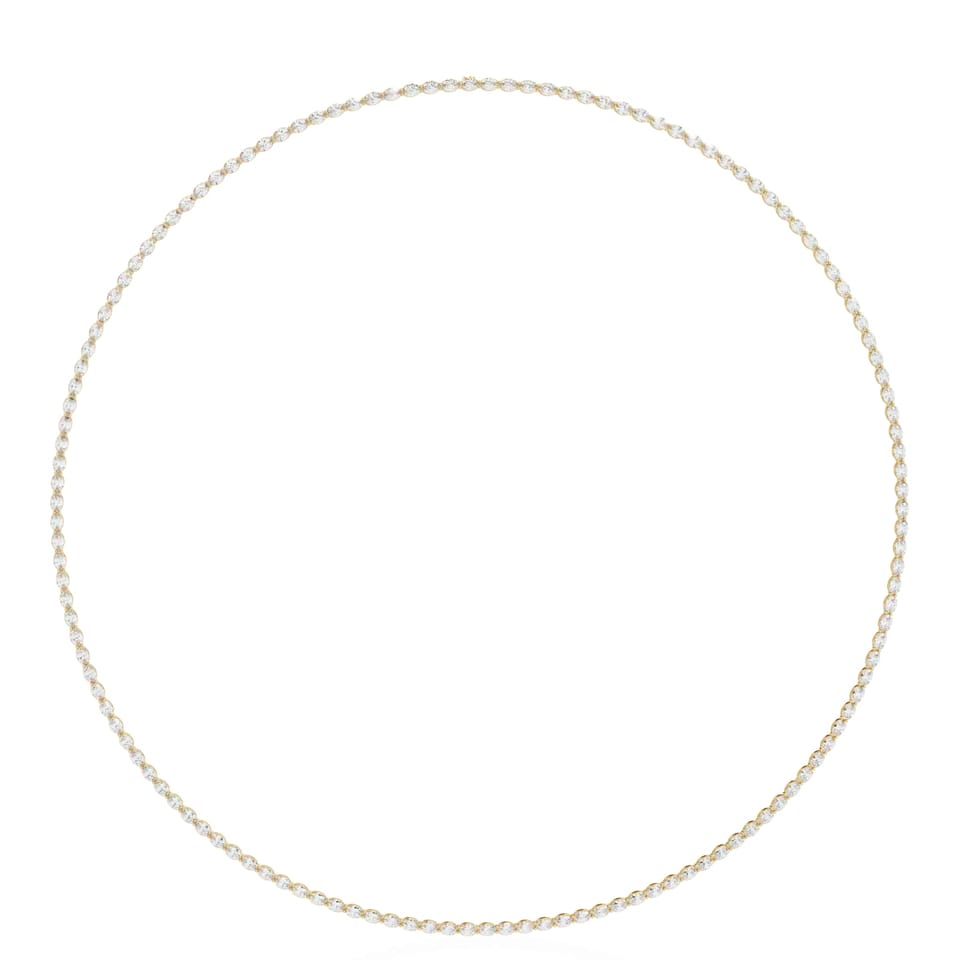
That is also why a different length is a different necklace: with one stone to every link, a longer or shorter line means more or fewer links, and so more or fewer stones. Other lengths are made on request and quoted separately.
The weight of a line
The drawing weighs the metal too. It measures the volume of every rim, rail and claw once, and the weight in each metal follows from that volume and the metal’s density. So the same necklace is 15.42 g in 9K gold, 15.94 g in 10K, 17.93 g in 14K and 21.45 g in 18K, and 14.42 g in silver. The shape is the same in every metal; only the weight changes.
What the karats mean is in our guide to gold karats. The rest happens in our workshop in Surat, where the design is drawn, the metal is cast and the stones are set.
Its portrait, then the post
Every piece is checked at setting, at finishing and again before it is packed. When the necklace is finished, we photograph it and send you the photograph before it ships: your own necklace, not the render on this page.
You can also choose moissanite for the same design. It is a different stone, not a diamond, and it doesn’t come with an IGI report. Neither does the laboratory-grown version of this necklace: an IGI report comes with a laboratory-grown main stone above 1 carat, and each of these ovals is about 0.05 ct.
Read next
- Journal
How to care for laboratory-grown diamond and moissanite jewellery
 The oval, turned the other way
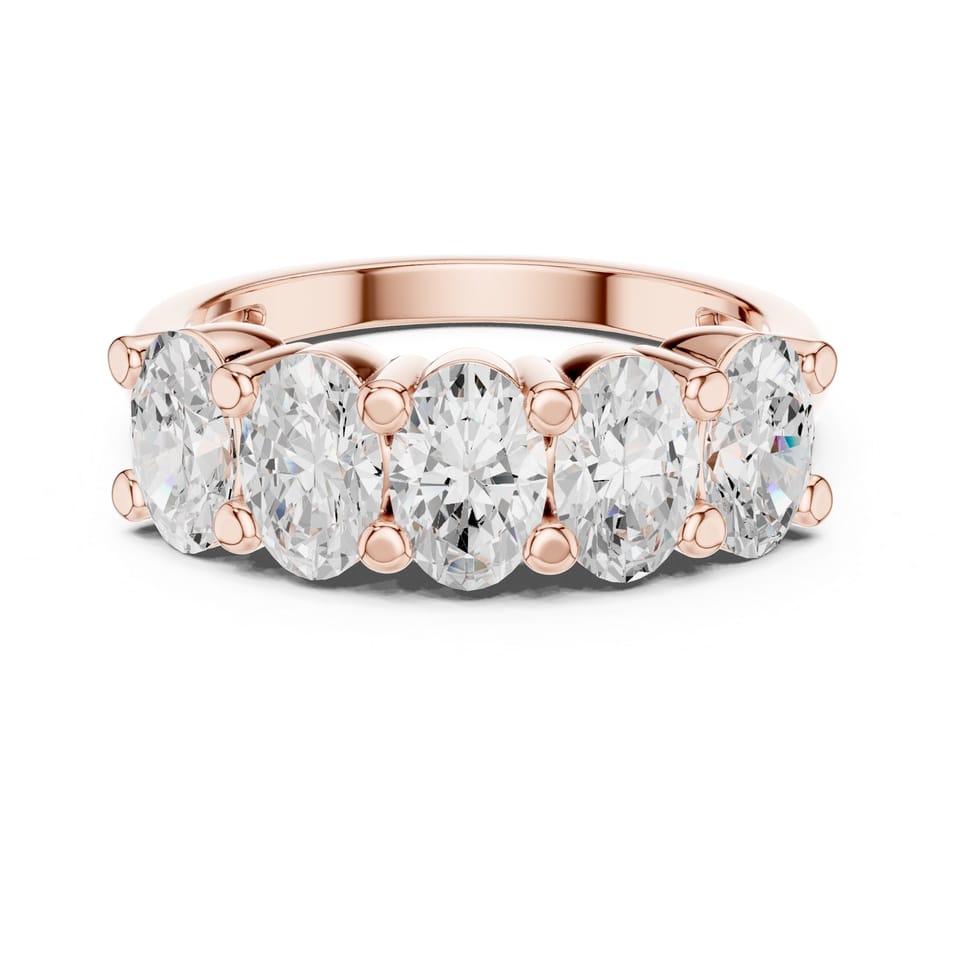
5 ovals of 6.00 × 4.00 mm, 1.80 ct, in shared claws
- Journal
Oval, emerald, pear or radiant: choosing a stone shape
- A Piece’s Life
Nineteen stones, one circle: the life of an emerald-cut eternity band
Quick answers
- What does east-west mean in jewellery?
- It describes a long stone, such as an oval, turned so that its length lies along the line of the piece. On a ring, GIA describes an east-west oval as one set horizontally across the finger; our east-west necklace turns each oval the same way, so its length lies along the line of stones.
- How many stones are in VIBHINI’s east-west tennis necklace?
- It holds 137 ovals of 3.00 × 2.00 mm, 6.20 ct in all in laboratory-grown diamond, each in a link of its own, as its CAD draws them.
- Why is each oval set in its own link?
- So the line can bend. Each oval sits in an open basket of its own, joined to the next at a pair of claws, so the necklace can follow a curve and lie flat, as its renders show.
- What does the necklace weigh in gold and in silver?
- From its CAD: 15.42 g in 9K, 15.94 g in 10K, 17.93 g in 14K and 21.45 g in 18K gold, or 14.42 g in silver. The shape is the same in every metal; only the weight changes.
Ask us
Would you like this necklace made for you?
Tell us the metal and gold colour you would wear, or the length you have in mind. You deal with Nikunj and Vishrut directly, on WhatsApp or by email.
Monday to Saturday, 10am to 7pm India time. WhatsApp +91 70434 07831.
Buying for a shop or brand? See our trade terms · Trade WhatsApp +91 84607 61366
Sources
Nikunj Koshiya, Co-founder. Nikunj Koshiya and his brother Vishrut founded VIBHINI on 14 November 2025, building on three generations of their family’s manufacturing in Surat. Nikunj looks after sales and customer care.
- VIBHINI: the CAD record of design VNK00038 (stones, carats, metal weights, setting) and its renders, and the published pages About (the design drawn, the metal cast and the stones set in Surat, and every piece checked at setting, at finishing and again before it is packed) and Questions and Answers (every finished piece photographed, and the picture sent before it is dispatched).
- GIA 4Cs blog, its guide to the oval cut, 23 September 2025: ovals among the shapes cut once the brilliant style appeared around 1700; the oval named as a shape in gem books from the late 1800s; the modern oval brilliant developed by the cutter Lazare Kaplan in 1957, with 58 facets; an east-west oval set horizontally across the finger. 4cs.gia.edu
- Mechelle Lois, “Making and Setting a Basket Setting”, Ganoksin, updated 23 April 2025: the basket as an open-wire design that uses very little metal and lets light enter the stone from all angles. ganoksin.com
- Wikipedia, “Carat (mass)”: the metric carat of 200 milligrams. en.wikipedia.org/wiki/Carat_(mass)
Every date and figure in this story comes from the sources above. If you know of a better one, tell us and we will check it. Facts checked 12 October 2026.