Trade: loose laboratory-grown diamonds
Loose Laboratory-Grown Diamonds Cut to Order for the Trade
For the trade only: jewellers, designers, wholesalers and brands, in India and abroad. Our workshop in Surat cuts and polishes laboratory-grown diamonds to order: old mine, old European, rose and Portuguese cuts; kites, shields, hexagons, half moons, trapezoids, trillions, Dutch marquises and movals; Asscher, baguette and other step cuts; and cuts made to your drawing. We also sort and calibrate melee, and match pairs and layouts.
What we cut, and in which grades
Every loose stone we supply is a laboratory-grown diamond, sold to trade buyers only. Our loose stones run from about 0.90 mm to 20 carats, depending on the shape. Colour runs from D to J and clarity from IF to SI; other grades can be sourced on request, and fancy colours are on request. For the stones we hold ready, see loose laboratory-grown diamonds.
Send your brief by trade WhatsApp to +91 84607 61366 or by email to info.vibhini@gmail.com, and we come back with what we can cut, and what it costs. Buying a stone for a ring of your own? We don't sell loose stones to private buyers, but our Bespoke service makes jewellery to your design.
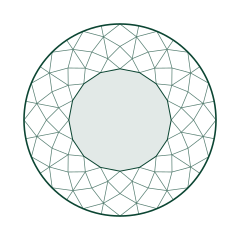
Portuguese cut
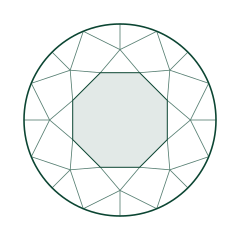
A Portuguese-cut laboratory-grown diamond is cut deep, with row after row of facets, ring within ring, above and below the girdle. The classic design is round. Tell us the diameter in millimetres, the number of rows (or a faceting diagram if you have one), the total depth your setting can take, and whether you need a matched pair.
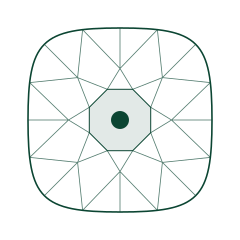
Old mine cut
An old mine cut laboratory-grown diamond is cut new in the style of the hand-shaped brilliants of the eighteenth and nineteenth centuries. It has a soft, squarish cushion outline, a high crown, a small table and a large culet, which you can often see through the top of the stone. Tell us the length and width in millimetres, which decide how square or how long it looks, how large a culet you want, and the total depth if the stone has to sit at a set height.
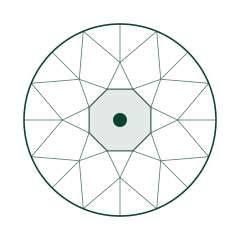
Old European cut
An old European cut is round, with a high crown and a small table, and it is deeper than a modern round brilliant. Its culet is smaller than an old mine cut's but still visible. It was the main round cut from the late nineteenth century to the early twentieth, and an old European cut laboratory-grown diamond is cut new in that style. Tell us the diameter in millimetres, and the total depth if the stone has to sit at a set height.
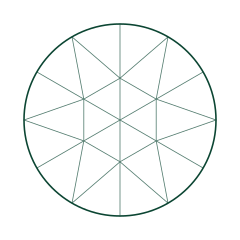
Rose cut
A rose cut laboratory-grown diamond has a flat base under a dome of triangular facets that rises to a point. It has no table and no culet. The classic outline is round. Tell us the diameter in millimetres, the height of the dome, and the number of facets if your design depends on it.

Kite cut
A kite-cut laboratory-grown diamond has four sides: two short sides meet at one end and two long sides at the other. It can be faceted in long, parallel steps or as a brilliant, and set alone, as a side stone, or point to point with others in a line or a star. Tell us the length and width in millimetres, the faceting you want, and how the stones meet if they are for a layout.
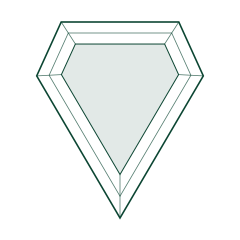
Shield cut
A shield-cut laboratory-grown diamond has a straight top, two shoulders and sides that taper to a single point, like the outline of a crest. Tell us the length and the width across the shoulders in millimetres, the faceting you want, and whether it is a centre stone or one of a pair.
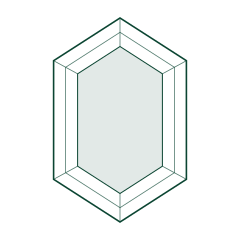
Hexagon cut
A hexagon-cut laboratory-grown diamond has six sides. It can be regular, with all six sides equal, or elongated, with two long parallel sides that sit square beside a band or the next stone. Hexagons fit edge to edge like a honeycomb, so they suit layouts. Tell us whether you want regular or elongated, and the size in millimetres. For a regular hexagon, say whether you measured it across its flat sides or across its corners.
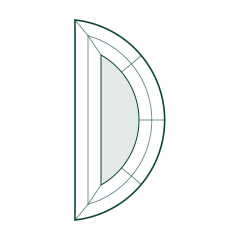
Half moon cut
A half moon cut laboratory-grown diamond has one straight side and one curved side. Half moons are usually set as a pair, one on each side of a centre stone, with the straight side against it. Tell us the shape and measurements in millimetres of the centre stone in your design, so we can cut the straight sides to meet its edges, and how far out you want the pair to reach.
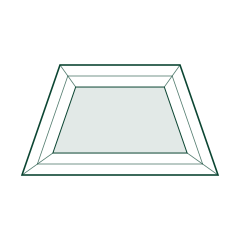
Trapezoid cut
A trapezoid cut, which cutters call a trapeze, has four sides, two of them parallel. A pair of trapezoid laboratory-grown diamonds is usually set with the longer parallel side against the centre stone, tapering away from it. Tell us the centre stone's measurements, or the long side, short side and length of each trapezoid in millimetres, and whether you need one pair or a graduated set.
Trillion cut
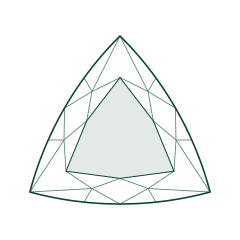
A trillion-cut laboratory-grown diamond has three sides, straight or gently curved. It is set as a centre stone or, more often, as a pair of side stones. Tell us the length of a side in millimetres, whether the sides are straight or curved, and whether you need a pair.
Dutch marquise cut
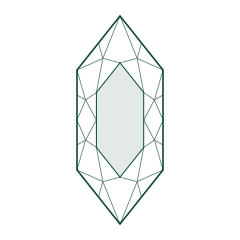
A Dutch marquise laboratory-grown diamond is a marquise outline drawn with straight sides: long, six-sided and pointed at both ends. Tell us the length and width in millimetres, and whether it is a centre stone or one of a pair.
Moval cut
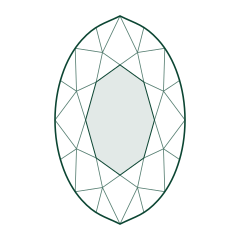
A moval laboratory-grown diamond sits between a marquise and an oval: longer and more pointed than an oval, with softer ends than a marquise. Tell us the length and width in millimetres, which decide how close it comes to either shape.
Asscher, baguette and other step cuts
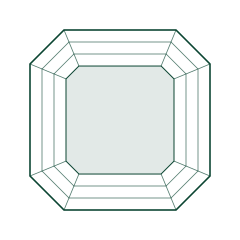
Step cuts have rows of long, parallel facets, like steps, instead of the triangular facets of a brilliant. The Asscher is square with cut corners; the baguette is a long, narrow rectangle, often set in rows or beside a centre stone. Tell us the shape, the length and width in millimetres, and for baguettes the number you need for each row.
Matched pairs and layouts
A matched pair is two laboratory-grown diamonds alike in shape, size, colour and clarity, for earrings or for the side stones of a ring. A layout is a whole set of stones matched to fit one design, such as a graduated line or a cluster. Tell us what the stones are for, the size of each position in millimetres, and how closely the stones must match. A drawing that marks every position saves questions.
Melee
Melee is the trade's name for the small stones set in pavé, halos, bands and clusters. We sort and calibrate laboratory-grown diamond melee to size, so that the stones in a row match. The smallest loose stones we supply are about 0.90 mm. Tell us the shape, the size in millimetres (or the sieve size you buy by), the quantity in stones or in carats, and the colour and clarity.
Cut to your drawing
We cut laboratory-grown diamonds to a buyer's drawing, including the cuts on this page in your own proportions. A drawing we can quote from shows three things:
- the outline from above, with its length and width in millimetres;
- the profile from the side, with the crown height and the total depth;
- the facets, as a faceting diagram or a sketch, if you have them.
If all you have is a sketch or a photograph, send it with the measurements of the space the stone must fit, and we will tell you what else we need.
Your brief
Send a brief for each stone, or for each set of stones, and we come back with what we can cut, and what it costs. A complete brief covers six things:
- The exact shape. A drawing, or the shape and its ratio of length to width.
- The size of every stone. In millimetres, for each stone or each position in a layout. A carat weight alone doesn't fix the outline of a fancy shape.
- How many, and how they go together. The number of stones, and which must be pairs or part of a layout. Melee by the number of stones or by total carats.
- The colour and clarity. Colour from D to J and clarity from IF to SI. Other grades can be sourced on request, and fancy colours are on request.
- The report. The report you need, and for which stones.
- The date and the destination. When you need the stones in hand, and the country they are going to.
Every order is quoted and agreed in writing. For buyers outside India, payment and shipping follow our trade terms for buyers abroad.
Quick answers
- Can you cut laboratory-grown diamonds to my own drawing?
- Yes. Our workshop in Surat cuts and polishes laboratory-grown diamonds to a trade buyer's drawing. Send the outline and side profile with their measurements in millimetres, the facets if you have them, the quantity, the colour and clarity, and the report you need, and we reply with what we can cut and what it costs.
- Which fancy shapes and antique-style cuts do you cut to order?
- Kites, shields, hexagons, half moons, trapezoids, trillions, Dutch marquises and movals; old mine, old European, rose and Portuguese cuts; and Asscher, baguette and other step cuts. All are laboratory-grown diamonds, cut and polished in our own workshop in Surat for trade buyers.
- Can you cut half moons and trapezoids to fit a centre stone?
- Yes. Send the shape and measurements in millimetres of the centre stone in your design, and we cut the pair so that their straight sides meet its edges. Tell us the colour and clarity, and whether you need one pair or a graduated set.
- Do you supply laboratory-grown diamond melee calibrated to size?
- Yes. We sort and calibrate laboratory-grown diamond melee to size, so that the small stones in a row of pavé or a halo match. Tell us the shape, the size in millimetres or the sieve size, the quantity, and the colour and clarity.
- Can you match laboratory-grown diamonds in pairs and layouts?
- Yes. We match pairs, for earrings or side stones, and whole layouts, such as a graduated line or a cluster. The surest brief is a drawing that marks each stone's position and size in millimetres.
Ask us
Send the whole brief, or only the shape you have in mind, and we will tell you what we can cut. You can attach a drawing to either message.
- Trade WhatsApp, with the message started for you: +91 84607 61366
- Phone: +91 84607 61366
- Email, with the subject and the same lines filled in: info.vibhini@gmail.com
- Hours: Monday to Saturday, 10am to 7pm India time (IST)
- Video calls, or a visit to our office in Surat, by appointment. The address is on our Contact page.
Buying one piece for yourself? That is Bespoke. Our trade page covers jewellery made for your brand.